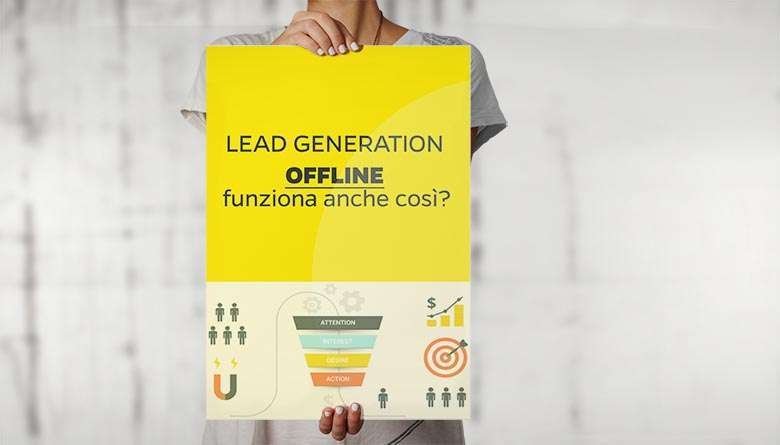
Lead Generation offline: does it work like this too?
Is this extraordinary web marketing technique applicable to traditional promotion systems as well? Yes — offline Lead Generation exists and, when paired with online, it can work great… Talking about lead generation offline [...]

Indice dei contenuti
Is this extraordinary web marketing technique applicable to traditional promotion systems as well?
Yes — offline Lead Generation exists and, when paired with online, it can work great…
Talking about lead generation offline is not a contradiction. True: it’s one of the most effective web marketing strategies, born and developed in the digital world. However, limiting it exclusively to online would mean giving up huge potential, especially for businesses operating in well-defined local areas.
In this article we’ll see how lead generation can be successfully applied to traditional promotional tools, and especially how integrating online and offline is today the real competitive lever for local shops, neighborhood businesses, professionals and SMEs.
Lead Generation offline: what we’re really talking about
When you hear lead generation you immediately think of digital funnels, advertising, landing pages, marketing automation, CRM and email campaigns. All correct. But the definition of lead generation is much broader: it means generating qualified contacts, i.e. people genuinely interested in your products or services.
If that’s the goal, the channel becomes secondary.
A contact can come from:
- an online form
- a phone call
- a QR code on a flyer
- a loyalty card filled out in store
- a request for information at a trade fair
That’s why talking about lead generation offline is not only correct, it’s strategically smart.
The role of territory in contact acquisition strategies
Think of all the local businesses that base their business on a specific geographic area:
- neighborhood shops
- restaurants
- gyms
- beauty centers
- professional offices
- dealerships
- showrooms
For these businesses the territory is not just a detail: it’s the main market.
Of course digital allows advanced geotargeting. Tools like Google Ads or Facebook Ads let you reach users in very specific areas. You can show ads only to people who live within 5 km of the shop, or to those who frequent certain zones.
But there’s a structural limit: not everyone is online when you want to reach them.
That’s where offline comes into play.
The continuing value of traditional advertising
Posters, flyers, brochures, handbills, billboards: tools many consider outdated, but that actually retain enormous strength, especially locally.
It happens every day:
- flyers in mailboxes
- flyers handed out on the street
- promotions left in partner stores
- postings in the neighborhood
If you live in a small-to-medium town, the whole municipality can be a plausible target. In big cities like Milan or Rome the story changes: different neighborhoods mean different audiences, habits and purchasing power.
Offline allows a physical presence in the territory that digital alone cannot replicate.
Lead Generation online and offline can coexist. In fact… they must
The real point is not choosing between traditional and digital marketing. The point is integrating them.
Online and offline lead generation work better when they work together.
This is even more true for local businesses that need to:
- become known locally
- build trust
- generate in-store traffic
- retain customers
If you run a local business, connecting online and offline isn’t optional: it’s a strategic necessity.
The flyer as a paper landing page
Take one of the most classic tools: the flyer.
Many see it as simple informational advertising. In reality it can become a powerful lead generation tool if designed with digital logic.
The rules are similar to an effective landing page:
- strong headline
- clear value proposition
- immediate benefit
- call to action
- urgency or incentive
The goal is not to inform. The goal is to prompt action.
Online the action is filling a form. Offline it can be entering the store… or going online.
And that’s where real integration is born.
From paper to digital: the bridge that generates leads
Imagine this scenario.
You distribute flyers in your neighborhood. But instead of just describing your services you include:
- a link
- a QR code
- a discount code
- a reserved promo
For example: “Scan the QR code and get 20% off.”
At that moment you’re turning an offline tool into an online lead generation channel.
Those who scan:
- leave data
- download a coupon
- enter your funnel
- become trackable
Measuring what was previously invisible
One historic limit of traditional marketing has always been the inability to measure results.
How many people saw the poster?
How many flyers worked?
Which area performed best?
By integrating digital elements you can finally measure the return on investment (ROI) of offline campaigns too.
You can know:
- how many coupons were redeemed
- how many QR codes were scanned
- how many landing visits were generated
- how many sales resulted
You turned traditional promotion into a data-driven system.
You have your leads. You generated them… offline
Thanks to a flyer, brochure or poster you generated qualified contacts.
Lead Generation offline.
Not only that:
- you have emails
- you have phone numbers
- you have preferences
- you have interaction history
Precious data for any future strategy.
The strategic advantage of hybrid statistics
Integrating offline and online is not only about generating contacts. It’s about gathering insights.
You can discover:
- which neighborhoods respond better
- which offers convert more
- which formats work
- which periods perform
Information that improves:
- digital campaigns
- print campaigns
- commercial offers
- pricing
Cold calling vs territorial advertising: don’t get confused
Many associate offline lead generation with invasive techniques like cold calling. But that’s not the focus.
Effective traditional tools today are:
- targeted flyers
- direct mail
- local events
- trade fairs
- open days
- strategic postings
They are non-invasive channels with high territorial visibility.
The two major limits of offline (and how to overcome them)
Historically traditional marketing has had two major issues:
- defining the target
- measuring results
Today both can be overcome thanks to digital integration.
Target
Targeted distribution based on real data.
Measurement
Tracking via codes, personalized URLs and dedicated landing pages.
QR codes, coupons and dedicated landings: key tools
- QR Code → immediate access to landing or promo
- Unique discount codes → conversion tracking
- Personalized URLs → traffic source analysis
- Contests → data collection
- Digital loyalty cards → customer database
Events and trade fairs: relational lead generation
Trade fairs, open days, workshops and openings let you:
- meet prospects
- build trust
- explain services
- collect contacts
By digitalizing the process:
- online registration
- QR badges
- email follow-up
- post-event automations
Omnichannel strategies: the real competitive advantage
The most effective strategies today are omnichannel.
A user can:
- receive a flyer
- visit the landing
- leave an email
- receive a promo
- enter the store
One path, more touchpoints, higher conversion.
From physical traffic to owned database
A main goal of modern lead generation is building owned databases.
Offline lets you transform:
- walk-in customers
- passersby
- event visitors
into contacts you can activate with marketing automation.
Conclusion: an extraordinary weapon for local business
Now you know that online and offline marketing are not separate worlds.
They can integrate, amplify each other and multiply results.
You now know it’s possible to:
- generate leads with flyers
- track print campaigns
- measure offline ROI
- build customer databases
If you run a neighborhood shop or a local business you have an extraordinary weapon to promote your business and boost your revenue.
The difference isn’t the channel you use, but the strategy you decide to integrate them with.
Condividi questa storia, scegli tu dove!
About the Author: Gentian Hajdaraj