Web Marketing Strategies You Must Not Ignore

Web marketing is one of the most effective ways to promote products and services online, but in 2026 reducing it to mere promotion would be extremely limiting. Today it is a complex ecosystem that combines strategy, technology, content, data and automation with a single goal: attract qualified users and turn them into loyal customers.

There is no one-size-fits-all formula for success in any online business. Much depends on the type of activity, target market, level of competition and the budget you are willing to invest. However, there is a common element: without visibility there is no growth, and without a solid strategy visibility remains random and hard to reproduce.

Online advertising is one of the quickest ways to generate traffic, but alone it is not enough. Without an integrated strategy it risks producing temporary results that vanish as soon as you stop investing in ads. It is through the combined use of web marketing strategies that you can build a lasting customer acquisition system, capable of supporting growth over time and generating real value for your business.

The internet is a highly competitive environment. Millions of businesses promote services similar to yours every day. What makes the difference is not only the quality of the offer, but the ability to be found, communicate value and build trust. In this context, knowing the most effective web marketing strategies is not a competitive advantage: it is a necessity.

If you are launching an online business or want to consolidate your digital presence, understanding how web marketing strategies work today is fundamental to achieving concrete, measurable and repeatable results over time.

The evolution of Web Marketing: from promotion to strategic ecosystem

Over the past fifteen years digital marketing has gone through several evolutionary phases. Initially, having a website and investing in banner ads was enough to get traffic. Then social networks arrived, radically changing how to communicate with the public and build relationships with potential customers.

Structured SEO, content marketing, marketing automation and finally artificial intelligence applied to every stage of the funnel followed. Today we are in a completely different phase, dominated by data, AI and strong personalization.

Modern web marketing no longer works only on visibility, but on the entire user journey. It means analyzing behavior, understanding needs, anticipating intent and building tailored experiences that guide the user from the first search through purchase and loyalty.

The user is no longer a passive recipient but an active part of the process. They compare, evaluate, read reviews, watch videos and interact with the brand across multiple channels before deciding. The so-called “zero moment of truth” increasingly happens online, and those who don’t own that moment lose real opportunities.

For this reason marketing strategies must be integrated, coherent and able to adapt to market changes in real time.

Prepare a plan and set objectives

One of the most important — and often underestimated — strategies is planning. Without a precise plan, marketing becomes a set of disconnected activities that consume budget without generating meaningful results. You act on impulse, chase trends and lose sight of the final goal.

It is necessary to set clear, measurable and realistic objectives, and establish a detailed promotion plan that includes channels, messages, timing and required resources. Monitoring results lets you understand which activities generate value and which should be removed or optimized.

Defining priorities allows you to allocate budget better and focus efforts on the actions most effective for your specific market context.

Goals for web marketing strategies can include:

  • increasing website traffic
  • generating qualified leads
  • boosting online sales
  • requests for quotes or demos
  • growing brand awareness
  • retaining existing customers
  • positioning as an industry authority

Considering all areas of digital marketing allows you to choose those best suited to your market, products or services. Not all strategies work the same for every business. A B2B company will need a different mix than a B2C e-commerce, and a startup will have different needs than an established company.

Blogs, articles and editorial content

A company blog is one of the most powerful web marketing tools. Writing articles helps you get noticed, demonstrate expertise and build authority over time — a key asset in a market saturated with similar offers.

Through content you can answer user questions, educate the market and capture qualified traffic at every stage of the funnel: from awareness to consideration and purchase decision.

The blog is also a powerful web marketing tool because it helps you rank better in search engines. Every indexed piece of content becomes an entry point to your site, active 24/7 without additional advertising costs.

In 2026 content marketing has been enhanced by AI, which can analyze user searches, identify the most relevant keywords and create content optimized for both traditional search engines and new AI-powered engines like SearchGPT and Google SGE.

But beware: quality matters more than quantity. Publishing shallow content written only for search engines with no real value for the reader is a strategy that no longer works in 2026. Google increasingly rewards content that demonstrates real experience, vertical expertise, authority and trustworthiness: the E-E-A-T criteria.

An editorial strategy must start with a deep understanding of your audience, their problems, questions and aspirations. Only then does content become an effective and lasting customer acquisition tool.

SEO: visibility that captures demand

SEO is one of the web marketing strategies with the best long-term investment-to-return ratio. It allows your site to appear when a user actively searches for what you offer. Unlike advertising, it doesn’t interrupt the user but answers a need expressed at that precise moment.

Being present in search results means owning one of the most important moments in the decision process, when the user is already motivated to find a solution and is evaluating options.

Today SEO also includes conversational searches and AI-based engines. Work is no longer only on isolated keywords but on semantic entities, domain authority, backlink quality and thematic coherence across the site.

On-page SEO: content optimization, heading structure, meta descriptions, internal linking, user experience and loading speed. Every page must fully and accurately satisfy the user’s search intent.

Off-page SEO: building authoritative links from relevant industry sites, brand mentions and digital PR. Online reputation is a determining factor for ranking.

Technical SEO: site structure, crawlability, indexability, schema markup, Core Web Vitals. A technically flawless site is the foundation for any ranking strategy.

Local SEO: crucial for businesses with a physical location or serving a specific area. Google Business Profile, reviews and local citations are key elements.

Investing in SEO means building a lasting asset. Unlike paid ads that generate traffic only while you invest, organic ranking continues to bring visitors after the work is done. That’s why it’s one of the web marketing strategies with the highest medium- and long-term ROI.

Read also: 16 rules to launch a successful SEO campaign

Social Media Marketing

Social media are among the most powerful channels to spread content and build relationships with your audience. But in 2026 using them well means much more than posting occasionally and hoping someone sees it.

Platforms like Facebook, Instagram, LinkedIn and YouTube let you reach large, profiled audiences but require specific strategies tailored to each platform’s characteristics.

Through social media marketing you can create interest, spark conversations, build communities and strengthen brand perception over time. The key is consistency: a brand that communicates irregularly struggles to build trust.

In 2026 short video content, live streams and educational content are among the best-performing formats across platforms. TikTok reshaped user expectations for format and consumption speed, influencing Instagram Reels, YouTube Shorts and LinkedIn.

Platform choice must be strategic. It makes no sense to be everywhere if you cannot manage channels with continuity and quality. Better to focus on two or three platforms and manage them effectively than to spread resources thin across many poorly managed channels.

Social media marketing splits into two main areas: organic and paid. Organic reach has progressively declined on nearly all platforms in recent years, making it increasingly necessary to combine organic activity with paid campaigns to maximize visibility.

Email Marketing

Email marketing remains one of the highest-ROI channels among web marketing strategies. It lets you communicate directly with users who have already shown interest in what you offer, establishing a communication channel that doesn’t depend on social media algorithms.

Unlike social platforms, your email list is an asset you own. No algorithm change can erase your ability to reach subscribers.

Effective email marketing in 2026 goes far beyond a monthly newsletter. It means building automated email sequences that guide leads through the purchase journey, personalizing messages based on behavior and interests, and continuously testing subject lines, content and calls-to-action to improve performance.

It is essential to clearly state what the reader can expect. Simple, benefit-focused messages with a clear call-to-action drive action far more effectively than generic, rambling emails.

AI now enables personalization based on a user’s past behavior, significantly increasing open, click and conversion rates. Segmenting the list by demographics, interests or actions taken lets you send the right message to the right person at the right time.

Lead Generation

Generating traffic is not enough: you must turn it into real contacts, people who have expressed interest in your offer and with whom you can build a structured commercial relationship.

Lead generation is a fundamental web marketing strategy for any business selling professional services, high-value products or B2B solutions.

Through optimized landing pages, premium content (ebooks, webinars, guides, checklists) and dedicated offers you can collect data from interested users in exchange for value. This process, called a “lead magnet,” is the basis of any effective sales funnel.

An effective landing page must have a single objective, a clear message, an irresistible value proposition and a call-to-action that leaves no doubt about the action to take. Removing distractions, minimizing options and making conversion as simple as possible are elements that distinguish a converting landing page from one that wastes traffic.

Lead quality is often more important than quantity. A database of one thousand highly qualified contacts is worth much more than ten thousand indiscriminately collected leads.

Marketing Automation

Marketing automation lets you manage large-scale communications without sacrificing personalization. Automated emails, sequential follow-ups, dynamic segmentation and personalized notifications nurture leads over time, guiding them toward purchase.

Automation is especially effective for businesses with long sales cycles or e-commerce sites that want to recover abandoned carts, encourage repeat purchases and reactivate inactive customers.

A well-configured automation system works for you 24/7, sending the right message to the right person at the right time without manual intervention. This lets you scale marketing activities without increasing staff or budget proportionally.

In 2026 the most advanced marketing automation platforms natively integrate AI to automatically optimize communication flows based on results, suggest more effective segmentations and personalize content at an individual level.

Online Advertising

Digital advertising provides immediate visibility, unlike SEO and content marketing which take time to deliver results. Google Ads and social ads let you reach target users quickly, accelerating growth especially during early business stages or product launches.

Google Ads (Search): text ads that appear when a user actively searches for a keyword related to your offer. High purchase intent, generally higher conversion rates.

Google Ads (Display and Performance Max): visual ads and AI-driven campaigns that combine multiple formats and placements to maximize conversions across the Google network.

Meta Ads (Facebook and Instagram): ideal for brand awareness, lead generation and retargeting. They enable very precise demographic and behavioral targeting.

LinkedIn Ads: essential for B2B. They allow targeting by job role, industry, company size and seniority level.

YouTube Ads: effective for products and services that benefit from visual demonstration. Video formats build trust quickly and effectively.

Advertising success depends on the quality of the targeted audience, ad relevance, landing page quality and the ability to continuously optimize campaigns based on collected data.

The impact of Artificial Intelligence on Web Marketing strategies

AI is now integrated into almost every area of web marketing, radically changing how work is done and achievable performance. It is no longer a future trend: it is today’s reality, and ignoring it means operating with obsolete tools in an increasingly competitive market.

In copywriting AI accelerates content production and enables rapid testing of text variants. But human oversight remains essential to ensure accuracy, originality and a tone of voice consistent with the brand.

In chatbots and virtual assistants AI allows you to handle user requests automatically and personally, improving customer experience and reducing response times.

In advertising AI automatically optimizes campaigns in real time, allocating budget to the best-performing audience segments and formats. Google’s Performance Max and Meta’s Advantage+ campaigns are real examples of this approach.

In data analysis AI helps identify patterns and insights that would escape manual analysis, anticipating trends and identifying optimization opportunities.

Those who integrate AI intelligently into their web marketing strategies will gain a significant competitive advantage in the coming years.

Branding and Online Reputation

A strong brand is one of the most valuable assets a company can build digitally. It increases trust, reduces customer acquisition costs, generates word-of-mouth and creates a barrier to entry for competitors.

Coherent visual identity, clear positioning and a recognizable brand voice are key elements of any effective web marketing strategy. Branding is not a luxury reserved for large companies: even a small local business can build a strong brand in its market.

Online reputation is closely tied to branding. Reviews on Google, Trustpilot or industry portals influence purchase decisions. Actively managing online reputation, responding constructively to negative reviews and encouraging satisfied customers to leave positive feedback is an integral part of a mature web marketing strategy.

Analytics and measuring results

No web marketing strategy is complete without an effective measurement system. Data are the compass that lets you understand what works and what doesn’t, where to invest more and where to cut.

Monitoring traffic, conversions, cost per acquisition, customer lifetime value and return on investment allows you to make evidence-based decisions rather than relying on intuition.

Google Analytics 4, ad platform reports, SEO tool dashboards and social platform metrics should be consulted regularly and integrated into a single report that offers a comprehensive view of performance.

In 2026 data analytics has further evolved thanks to AI, which interprets large volumes of data quickly and provides automatic suggestions on how to improve performance.

The support of a Web Marketing expert

Understanding web marketing strategies is essential, but implementing them correctly requires technical skills, field experience and time. For many businesses, especially small and medium-sized ones, the most efficient solution is to rely on a web marketing expert who can define the strategy best suited to their context and manage its execution.

A professional brings an updated market view, knowledge of the most effective tools and the ability to avoid common mistakes that often waste budget and precious time.

Working with a consultant or specialized agency is not a cost but an investment that, if well managed, produces measurable and significant returns.

Conclusion

Web marketing in 2026 is a complex but extremely powerful ecosystem for those who navigate it with method and strategy. There is no single road to digital success, but there are fundamental principles shared by all businesses that grow online: visibility, value, trust and continuous optimization.

Applying the web marketing strategies described in this article correctly means building a durable growth system capable of delivering results over time and adapting to market changes. It means turning your website from a simple digital showcase into a true customer acquisition engine.

The starting point is always the same: a clear plan, measurable goals and the willingness to test, measure and optimize consistently. The rest follows naturally.

And which web marketing strategies are you putting into practice? Which are working best for your business?

Leave a comment below.
Marketing strategies: complete guide to growing your business (with AI, data and method)

If you want to grow a company for real, sooner or later you face a simple truth: without a clear direction, marketing becomes a set of disconnected activities. A post today, a campaign tomorrow, a newsletter when there’s “time.” The problem isn’t that these actions are wrong, but that they’re often not coordinated by a vision: they don’t answer the most important question, namely “where do I want to get to and why should my customer choose me?”

In this pillar guide on marketing strategies I’ll take you step by step to build a solid framework: from choosing the market and target to defining the offer, channels and KPIs. You’ll also find a section dedicated to artificial intelligence applied to marketing, not as a fad but as a concrete lever for analysis, personalization and optimization.

In short: an effective marketing strategy comes from three choices: positioning (why choose you), distribution (where you intercept demand) and measurement (how you understand what works). AI doesn’t replace strategy: it makes it faster and more precise when you have clear goals and reliable data.

What Is a marketing strategy (and what it isn’t)?

A marketing strategy is a plan of decisions that links business objectives (revenue, margins, pipeline, retention) to real customer behaviors. Practically, it’s the structure that lets you decide who you want to attract, what promise you make, how you make it credible and which channels you invest in to generate measurable results.

A strategy always includes a few pillars: market analysis, target definition, positioning, offer design, channel selection, messaging and measurement. It doesn’t need to be a 40-page document. It needs to be clear, shareable and above all usable for decision-making; otherwise it remains theory.

Strategy vs tactics: the difference that changes everything

Tactics are operational actions: Google Ads campaigns, Instagram posts, nurturing emails, an SEO article, a webinar. Strategy decides which of these actions make sense, in what order and for what purpose. It’s the difference between “doing marketing” and “doing marketing stuff.”

Example: saying “let’s do the newsletter” is a tactic. Saying “let’s build a relationship system to increase conversion and loyalty, segmenting by intent and lifecycle” is strategy. In the first case you send random emails. In the second you know who you’re writing to, why, and what behavior you want to generate.

What a marketing strategy is NOT

Many call a content calendar, a task list or a set of generic tips a “strategy.” In reality:
– It’s not “being everywhere,” because presence without purpose often just increases noise.
– It’s not “running ads,” because ads amplify mistakes too (weak offer, confused targeting, poor landing page).
– It’s not “writing content” if that content doesn’t intercept demand and guide decisions.

A true strategy makes it easier to choose what not to do. That’s precisely where you save time and budget.

Why clear marketing strategies matter

Strategy is crucial because it transforms marketing from an uncertain cost to a governable investment. Without a structure, you end up chasing short-term results, often changing direction every month. And when you don’t know what works, the temptation is always the same: increase activity and content hoping something will “stick.”

With a strategy you have a path: you know the ideal customer, the most credible message and which channels deserve attention. This reduces waste and increases consistency—two elements that over time build competitive advantage.

Marketing and artificial intelligence: what really changes

In recent years artificial intelligence has changed the speed at which you can analyze data, create message variants and test hypotheses. But note: it’s not an “autopilot” that brings customers by itself. It works well when you already have a strategic framework in place.

For example, AI can help identify patterns in user behavior (which pages they visit before buying), better segment an email list, or improve an ad campaign by optimizing creatives. But if you don’t know your promise, AI will produce generic content that looks like everyone else’s.

The 10-step method to create an effective marketing strategy
Below is a complete, ordered path. Treat it as a checklist: start from the point that’s weakest in your business today and progressively complete the others.

1. Analyze your market (demand, competitors and alternatives)

A solid marketing strategy always starts with context analysis. This doesn’t mean spending weeks on reports, but clarifying three things: what the market wants, who already serves it and what alternatives the customer chooses when they don’t buy from you.

The most underrated part is the last: often your main competitor isn’t a similar company but “do it myself,” “postpone,” or “use a cheap tool.” Understanding these alternatives helps you craft a more effective message because it answers real objections.

When analyzing competitors, don’t just look at the website. Observe how they position themselves, what proof they show, what prices they communicate and which channels they’re strong on. Tools like SEMrush or SimilarWeb can help, but a good manual analysis is often enough to find insights.

How to use AI in this phase

Treat AI as a “research assistant.” Use it to summarize reviews, extract recurring objections, create a positioning map and spot gaps. AI speeds up analysis, but the decision remains yours: which opportunities align with your capabilities, business model and margin.

2. Define target, ICP and buyer personas (without overcomplicating)

Saying “my target is companies” or “I target everyone” is the start of problems. An effective marketing strategy starts with a clear ideal customer profile, often called __WMA_TERM_48__ICP (Ideal Customer Profile). The ICP isn’t the biggest or wealthiest customer: it’s the one who buys most easily, has less friction, stays longer and generates more value.

From there build 2–3 buyer personas (not 10). They must be useful, not decorative: include elements that help write copy and choose channels—what are their goals, which fears block them, what metrics they must prove to their boss, what topics persuade them and what annoys them.

A practical test: if you can’t write a specific ad or landing page for a persona, it’s too vague.

3. Positioning: why choose you and not someone else

Positioning answers the question the customer won’t ask directly but that decides everything: __WMA_TERM_49__“Why should I choose you?” If you can’t answer simply and credibly, you end up competing on price or losing to better communicators.

Good positioning is built with a precise promise and evidence. No need for slogans—clarity is enough. Example: “I help e-commerce reduce CPA by 20% in 60 days with a method grounded in margin analysis and creative optimization.” That’s far more credible than “we improve your sales.”

Differentiation matters: you don’t need to be the best overall, you need to be the best choice for that customer, in that context, with that need.

4. Offer: the part that often matters more than marketing

Many look for marketing solutions when the real problem is the offer. If the offer is weak or confusing, marketing struggles: you can polish copy but you can’t create value out of nothing.

Designing an offer means deciding:
– what you actually include (and what you don’t);
– how you make it easy to start (reduce friction);
– what perceived risk the customer has and how you reduce it (trial, demo, guarantee);
– what proof you can show (case studies, examples, process, numbers).

A well-designed offer also makes SEO and advertising easier because you have concrete, differentiating arguments to communicate. You’re not saying “we’re good”; you’re showing “how it works and what you get.”

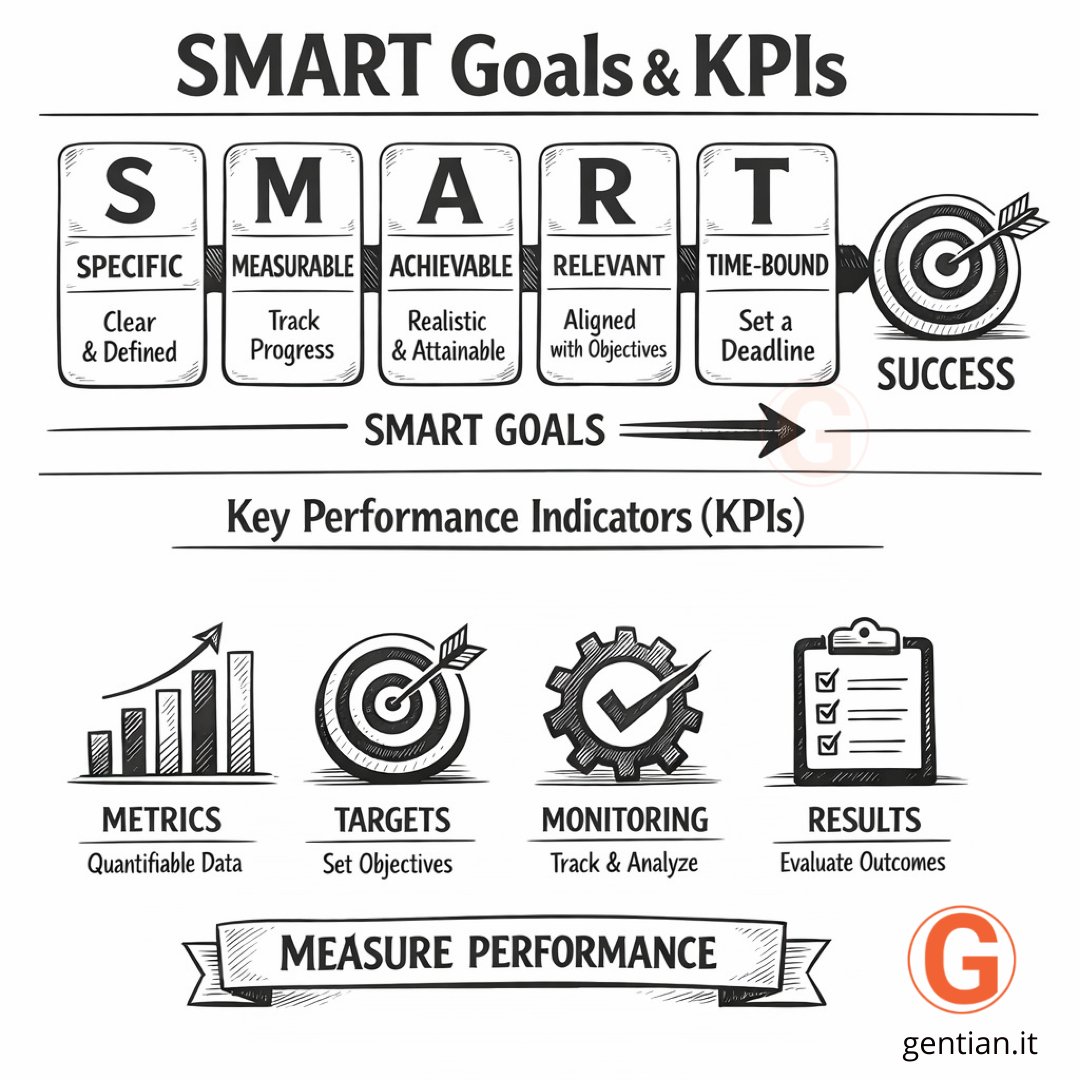
5. SMART goals and KPIs: measure what truly matters

SMART goals and KPIs

SMART goals work because they remove ambiguity. “I want to increase sales” is a wish. “I want to increase sales by 20% in 6 months through segmented email campaigns” is measurable.

Define a North Star Metric: a metric representing real value generated. It’s not necessarily revenue: it can be net MRR, gross margin, qualified leads or recurring orders. The key is to avoid vanity metrics.

If you only measure traffic and followers, you may improve those numbers while worsening the business. If you measure conversion, margin and retention, you can make better decisions.

6. Marketing channels: choose the right ones for your model

Not all channels work for everyone and not in the same way. SEO is an asset that grows over time; paid advertising is immediate but expensive without proper tracking and a strong offer; email marketing often works on monetization and retention, so it has huge ROI if you already have traffic or leads.

Your channel mix must have a reason. For example:
– SEO to intercept informed demand and build authority.
– Ads to accelerate testing and scale what already converts.
– Email/CRM to turn leads into customers and customers into recurring buyers.

7. Funnel and customer journey: turn attention into customers

A common mistake is believing marketing is only “bringing traffic.” Marketing is guiding someone from interest to decision. That path changes by price, required trust and customer type.

A simple effective funnel includes:
– a content or ad that intercepts a real need;
– a page that clarifies promise, proof and next steps;
– a nurturing sequence (email, retargeting, content) that handles objections;
– a coherent conversion (purchase, call, demo, quote).

AI can help a lot here: chatbots for FAQs, lead scoring for commercial prioritization, message personalization based on behavior. But again: build the path first, then automate.

8. Content plan: pillars, clusters and distribution (not just “writing”)

Content marketing works when it solves real problems and supports decisions. A pillar article like this targets a broad keyword (marketing strategies) and must be supported by cluster content: specific articles on subtopics (SEO, email marketing, branding, AI marketing, funnel, KPIs, etc.) that link to and reinforce the pillar.

Also, publishing isn’t enough—you must distribute. A strong piece of content can be:
– broken into a series of social posts;
– turned into a newsletter;
– repurposed as video scripts or a webinar;
– used for retargeting (ads to people who read but didn’t convert).

For content measurement, tools like Google Analytics show which articles bring just traffic and which drive actions (subscriptions, contacts, purchases).

9. Monitoring and optimization: effective marketing is a cycle

Marketing is never “finished.” It’s a continuous cycle of hypotheses, tests and optimization. If a campaign brings leads but few become customers, it doesn’t mean it “doesn’t work”: it means you must find where the path breaks (lead quality, offer, follow-up, proof, pricing).

Create a rhythm: monthly KPI reviews, choose 2–3 high-impact tests and run them. Over time this lets you grow without relying on luck.

10. Make the strategy repeatable and scalable

A strategy becomes powerful when it’s repeatable—when it doesn’t depend on a single “star” or a lucky period. Practically this means: if tomorrow the person managing campaigns changes, a new copywriter arrives, budget increases or a new channel opens, the system still works because it’s built on clear processes and measurable decisions, not improvisation.

To achieve this, turn the strategy into an operational manual containing elements that let the team work well as it grows:
– Checklist for recurring activities (campaign launch, article publication, funnel setup).
– Templates to speed and align production (creative briefs, landing pages, emails, monthly reports, video scripts).
– Dashboard with truly useful KPIs so decisions are data-informed, not feelings (qualified leads, CAC/CPA, conversion rate, margin, retention).
– Reporting and review routines (weekly and monthly) to understand what’s working and why.
– Priority rules: what to test first, how to decide to scale, when to stop a campaign.

The real leap is moving from “we do marketing” to “we run a growth system.” Here AI can be a concrete lever because it supports repeatability, for example by:
– automating reports and insights (performance summaries, anomalies, opportunities);
– helping create ad, email and creative variants to test structurally;
– supporting documentation (procedures, checklists, playbooks) and keeping it updated.

Attention: AI is useful if it works inside a process. If the process doesn’t exist, you automate chaos.

When you have a system, you can scale healthily because you don’t increase quantity and budget at random. Scale only after validating what truly holds:
– For paid advertising, increase budget only after proving the offer converts and acquisition cost is sustainable relative to margin. Increasing budget too early often worsens results by buying colder, less qualified traffic.
– For SEO and content, scale when you know which intents bring customers (not just visits). Otherwise you risk producing dozens of articles with “nice” numbers but no revenue.
– For automations (email, CRM, lead scoring, chatbot), introduce them after mapping the customer journey. Otherwise you automate the wrong messages at the wrong time, often harming conversions and brand perception.

In short: strategy becomes scalable when you have three things under control: unit economics (costs and margins), conversion (funnel and message) and process (repeatability). If any of these is missing, growth is fragile and easy to derail.

Examples of successful marketing strategies (with applicable lessons)
Coca-Cola, Nike and Amazon are often cited, but the point isn’t to copy them. Big companies have budgets, channels and advantages an SMB can’t replicate. The useful part is understanding the strategic principle behind them and adapting it realistically to your context.

Coca-Cola: personalization and social activation

With “Share a Coke,” Coca-Cola showed personalization can turn a common object into an experience. Printing names on bottles created a simple psychological mechanism: people bought not just a drink but a message to share. The campaign was naturally social: photos, gifts, mentions, collecting names.

Lesson for smaller businesses: you don’t need to personalize everything—personalize a high-impact touchpoint.

Examples:
– dynamic landing pages by industry (B2B) or need (B2C);
– emails with different content by intent and behavior;
– offers or bundles for specific segments;
– shareable experiences (quizzes, tools, personalized reports).

AI can make personalization scalable by producing coherent variants without multiplying costs and time.

Nike: storytelling, identity and brand consistency
Nike doesn’t just sell shoes. It sells an idea: discipline, ambition, overcoming limits. People buy Nike to feel part of that identity. “Just Do It” campaigns work because they’re consistent over time: the message changes form, not meaning.

Lesson: storytelling isn’t random stories but choosing a point of view and keeping it. Even an SMB can do this by deciding:
– what transformation it promises (from X to Y);
– which values to communicate (precision, speed, reliability, innovation);
– which tone to use (technical, direct, inspirational, ironic, etc.).

This clarity makes it easier to produce consistent content, ads and pages. AI can support tone-of-voice consistency and generate variants without “betraying” brand identity.

Amazon: data, UX and friction reduction

Amazon exemplifies a strategy focused on removing friction and increasing average value through personalization and recommendations. It’s marketing inside the product: every detail (search, reviews, logistics, one-click, suggestions) makes buying easier and repeat purchases more likely.

Lesson: growth often depends more on improving conversion and retention than on getting more traffic. Practical ideas:
– reduce steps to request a quote or buy;
– make proof clearer (case studies, FAQs, comparisons);
– introduce related product/service suggestions (cross-sell) based on behavior;
– improve onboarding and follow-up to raise perceived value and reduce churn.

AI is especially useful here because it can read behavior signals and suggest actions: recommended content, relevant offers, automatic support and lead prioritization.

The common principle (what really matters)

The common thread across these examples is constant and applies to small businesses too:
– Clear message: the user immediately understands “what you do for me.”
– Coherent offer: the promise is supported by a well-designed product/service.
– Proof or experience: something demonstrates it’s true (social proof, data, processes, UX).

When these three align, marketing stops being a gamble and becomes a multiplier. When they don’t, even the best campaign produces unstable or too costly results.

Conclusion

Marketing strategies put order into your efforts. They help you choose a target, build credible positioning, design an offer that converts and use channels with logic. Artificial intelligence can give you a huge advantage, but only if you plug it into an already sensible framework: otherwise it quickly produces mediocre content.

Practical advice: start with positioning + offer. Then pick 1–2 main channels, set KPIs and build a monthly optimization cycle. That’s how marketing stops being a collection of attempts and becomes a growth system.

Go to Top