

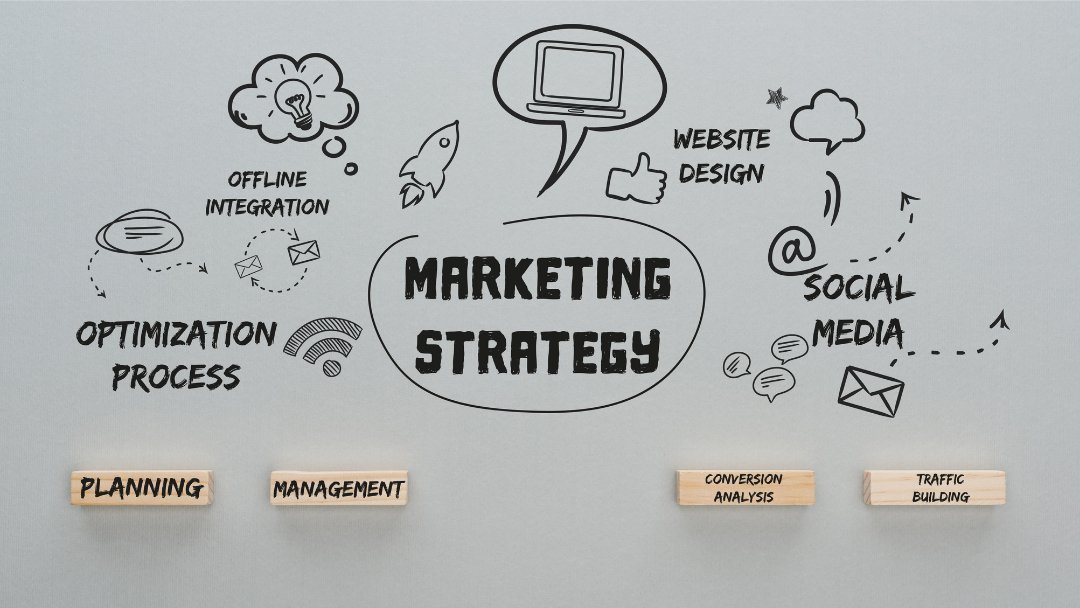
If you want to grow a company for real, sooner or later you face a simple truth: without a clear direction, marketing becomes a set of disconnected activities. A post today, a campaign tomorrow, a newsletter when there’s “time.” The problem isn’t that these actions are wrong, but that they’re often not coordinated by a vision: they don’t answer the most important question, namely “where do I want to get to and why should my customer choose me?”
In this pillar guide on marketing strategies I’ll take you step by step to build a solid framework: from choosing the market and target to defining the offer, channels and KPIs. You’ll also find a section dedicated to artificial intelligence applied to marketing, not as a fad but as a concrete lever for analysis, personalization and optimization.
In short: an effective marketing strategy comes from three choices: positioning (why choose you), distribution (where you intercept demand) and measurement (how you understand what works). AI doesn’t replace strategy: it makes it faster and more precise when you have clear goals and reliable data.
What Is a marketing strategy (and what it isn’t)?
A marketing strategy is a plan of decisions that links business objectives (revenue, margins, pipeline, retention) to real customer behaviors. Practically, it’s the structure that lets you decide who you want to attract, what promise you make, how you make it credible and which channels you invest in to generate measurable results.
A strategy always includes a few pillars: market analysis, target definition, positioning, offer design, channel selection, messaging and measurement. It doesn’t need to be a 40-page document. It needs to be clear, shareable and above all usable for decision-making; otherwise it remains theory.
Strategy vs tactics: the difference that changes everything
Tactics are operational actions: Google Ads campaigns, Instagram posts, nurturing emails, an SEO article, a webinar. Strategy decides which of these actions make sense, in what order and for what purpose. It’s the difference between “doing marketing” and “doing marketing stuff.”
Example: saying “let’s do the newsletter” is a tactic. Saying “let’s build a relationship system to increase conversion and loyalty, segmenting by intent and lifecycle” is strategy. In the first case you send random emails. In the second you know who you’re writing to, why, and what behavior you want to generate.
What a marketing strategy is NOT
Many call a content calendar, a task list or a set of generic tips a “strategy.” In reality:
– It’s not “being everywhere,” because presence without purpose often just increases noise.
– It’s not “running ads,” because ads amplify mistakes too (weak offer, confused targeting, poor landing page).
– It’s not “writing content” if that content doesn’t intercept demand and guide decisions.
A true strategy makes it easier to choose what not to do. That’s precisely where you save time and budget.
Why clear marketing strategies matter
Strategy is crucial because it transforms marketing from an uncertain cost to a governable investment. Without a structure, you end up chasing short-term results, often changing direction every month. And when you don’t know what works, the temptation is always the same: increase activity and content hoping something will “stick.”
With a strategy you have a path: you know the ideal customer, the most credible message and which channels deserve attention. This reduces waste and increases consistency—two elements that over time build competitive advantage.
Marketing and artificial intelligence: what really changes
In recent years artificial intelligence has changed the speed at which you can analyze data, create message variants and test hypotheses. But note: it’s not an “autopilot” that brings customers by itself. It works well when you already have a strategic framework in place.
For example, AI can help identify patterns in user behavior (which pages they visit before buying), better segment an email list, or improve an ad campaign by optimizing creatives. But if you don’t know your promise, AI will produce generic content that looks like everyone else’s.
The 10-step method to create an effective marketing strategy
Below is a complete, ordered path. Treat it as a checklist: start from the point that’s weakest in your business today and progressively complete the others.
1. Analyze your market (demand, competitors and alternatives)
A solid marketing strategy always starts with context analysis. This doesn’t mean spending weeks on reports, but clarifying three things: what the market wants, who already serves it and what alternatives the customer chooses when they don’t buy from you.
The most underrated part is the last: often your main competitor isn’t a similar company but “do it myself,” “postpone,” or “use a cheap tool.” Understanding these alternatives helps you craft a more effective message because it answers real objections.
When analyzing competitors, don’t just look at the website. Observe how they position themselves, what proof they show, what prices they communicate and which channels they’re strong on. Tools like SEMrush or SimilarWeb can help, but a good manual analysis is often enough to find insights.
How to use AI in this phase
Treat AI as a “research assistant.” Use it to summarize reviews, extract recurring objections, create a positioning map and spot gaps. AI speeds up analysis, but the decision remains yours: which opportunities align with your capabilities, business model and margin.
2. Define target, ICP and buyer personas (without overcomplicating)
Saying “my target is companies” or “I target everyone” is the start of problems. An effective marketing strategy starts with a clear ideal customer profile, often called __WMA_TERM_48__ICP (Ideal Customer Profile). The ICP isn’t the biggest or wealthiest customer: it’s the one who buys most easily, has less friction, stays longer and generates more value.
From there build 2–3 buyer personas (not 10). They must be useful, not decorative: include elements that help write copy and choose channels—what are their goals, which fears block them, what metrics they must prove to their boss, what topics persuade them and what annoys them.
A practical test: if you can’t write a specific ad or landing page for a persona, it’s too vague.
3. Positioning: why choose you and not someone else
Positioning answers the question the customer won’t ask directly but that decides everything: __WMA_TERM_49__“Why should I choose you?” If you can’t answer simply and credibly, you end up competing on price or losing to better communicators.
Good positioning is built with a precise promise and evidence. No need for slogans—clarity is enough. Example: “I help e-commerce reduce CPA by 20% in 60 days with a method grounded in margin analysis and creative optimization.” That’s far more credible than “we improve your sales.”
Differentiation matters: you don’t need to be the best overall, you need to be the best choice for that customer, in that context, with that need.
4. Offer: the part that often matters more than marketing
Many look for marketing solutions when the real problem is the offer. If the offer is weak or confusing, marketing struggles: you can polish copy but you can’t create value out of nothing.
Designing an offer means deciding:
– what you actually include (and what you don’t);
– how you make it easy to start (reduce friction);
– what perceived risk the customer has and how you reduce it (trial, demo, guarantee);
– what proof you can show (case studies, examples, process, numbers).
A well-designed offer also makes SEO and advertising easier because you have concrete, differentiating arguments to communicate. You’re not saying “we’re good”; you’re showing “how it works and what you get.”
5. SMART goals and KPIs: measure what truly matters
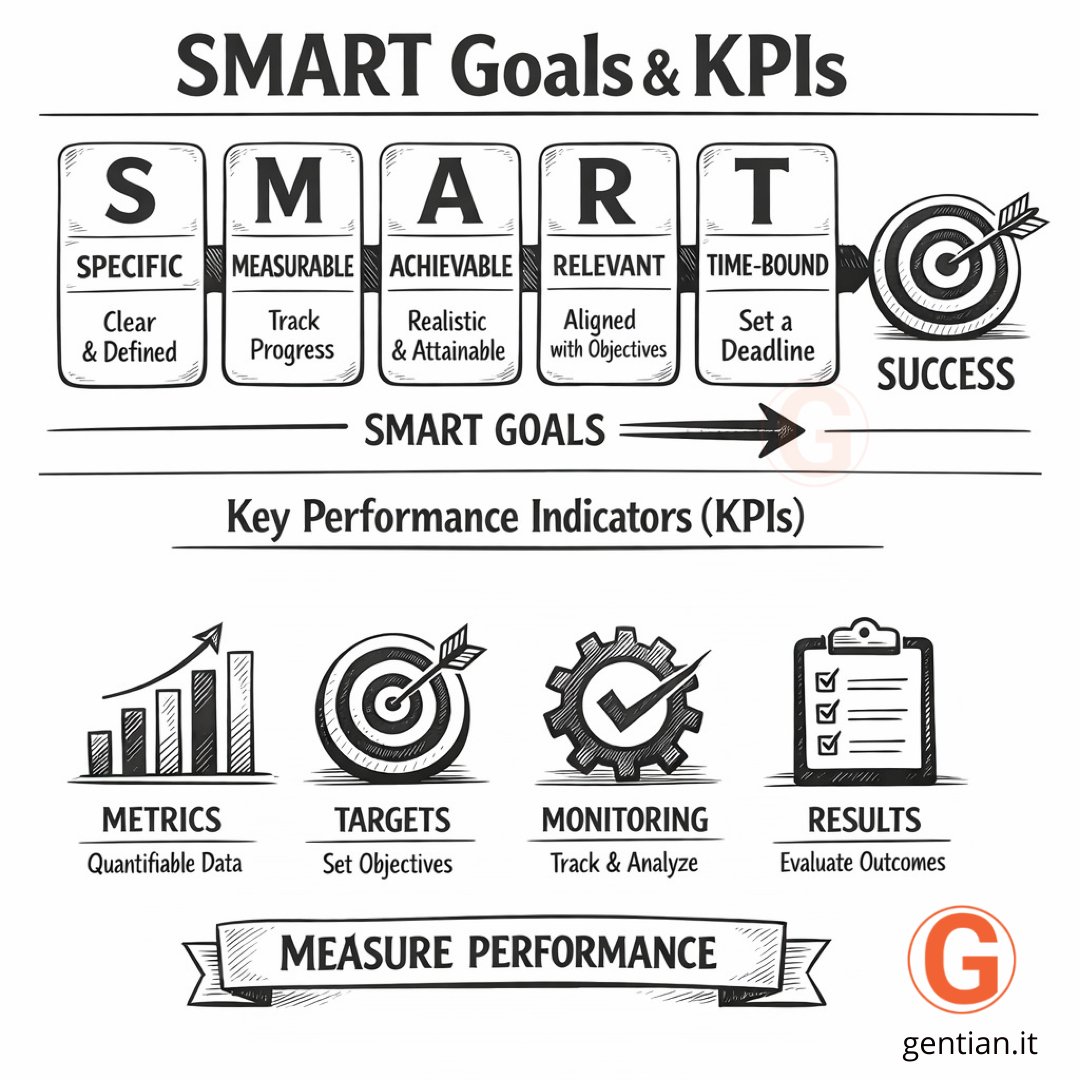
SMART goals work because they remove ambiguity. “I want to increase sales” is a wish. “I want to increase sales by 20% in 6 months through segmented email campaigns” is measurable.
Define a North Star Metric: a metric representing real value generated. It’s not necessarily revenue: it can be net MRR, gross margin, qualified leads or recurring orders. The key is to avoid vanity metrics.
If you only measure traffic and followers, you may improve those numbers while worsening the business. If you measure conversion, margin and retention, you can make better decisions.
6. Marketing channels: choose the right ones for your model
Not all channels work for everyone and not in the same way. SEO is an asset that grows over time; paid advertising is immediate but expensive without proper tracking and a strong offer; email marketing often works on monetization and retention, so it has huge ROI if you already have traffic or leads.
Your channel mix must have a reason. For example:
– SEO to intercept informed demand and build authority.
– Ads to accelerate testing and scale what already converts.
– Email/CRM to turn leads into customers and customers into recurring buyers.
7. Funnel and customer journey: turn attention into customers
A common mistake is believing marketing is only “bringing traffic.” Marketing is guiding someone from interest to decision. That path changes by price, required trust and customer type.
A simple effective funnel includes:
– a content or ad that intercepts a real need;
– a page that clarifies promise, proof and next steps;
– a nurturing sequence (email, retargeting, content) that handles objections;
– a coherent conversion (purchase, call, demo, quote).
AI can help a lot here: chatbots for FAQs, lead scoring for commercial prioritization, message personalization based on behavior. But again: build the path first, then automate.
8. Content plan: pillars, clusters and distribution (not just “writing”)
Content marketing works when it solves real problems and supports decisions. A pillar article like this targets a broad keyword (marketing strategies) and must be supported by cluster content: specific articles on subtopics (SEO, email marketing, branding, AI marketing, funnel, KPIs, etc.) that link to and reinforce the pillar.
Also, publishing isn’t enough—you must distribute. A strong piece of content can be:
– broken into a series of social posts;
– turned into a newsletter;
– repurposed as video scripts or a webinar;
– used for retargeting (ads to people who read but didn’t convert).
For content measurement, tools like Google Analytics show which articles bring just traffic and which drive actions (subscriptions, contacts, purchases).
9. Monitoring and optimization: effective marketing is a cycle
Marketing is never “finished.” It’s a continuous cycle of hypotheses, tests and optimization. If a campaign brings leads but few become customers, it doesn’t mean it “doesn’t work”: it means you must find where the path breaks (lead quality, offer, follow-up, proof, pricing).
Create a rhythm: monthly KPI reviews, choose 2–3 high-impact tests and run them. Over time this lets you grow without relying on luck.
10. Make the strategy repeatable and scalable
A strategy becomes powerful when it’s repeatable—when it doesn’t depend on a single “star” or a lucky period. Practically this means: if tomorrow the person managing campaigns changes, a new copywriter arrives, budget increases or a new channel opens, the system still works because it’s built on clear processes and measurable decisions, not improvisation.
To achieve this, turn the strategy into an operational manual containing elements that let the team work well as it grows:
– Checklist for recurring activities (campaign launch, article publication, funnel setup).
– Templates to speed and align production (creative briefs, landing pages, emails, monthly reports, video scripts).
– Dashboard with truly useful KPIs so decisions are data-informed, not feelings (qualified leads, CAC/CPA, conversion rate, margin, retention).
– Reporting and review routines (weekly and monthly) to understand what’s working and why.
– Priority rules: what to test first, how to decide to scale, when to stop a campaign.
The real leap is moving from “we do marketing” to “we run a growth system.” Here AI can be a concrete lever because it supports repeatability, for example by:
– automating reports and insights (performance summaries, anomalies, opportunities);
– helping create ad, email and creative variants to test structurally;
– supporting documentation (procedures, checklists, playbooks) and keeping it updated.
Attention: AI is useful if it works inside a process. If the process doesn’t exist, you automate chaos.
When you have a system, you can scale healthily because you don’t increase quantity and budget at random. Scale only after validating what truly holds:
– For paid advertising, increase budget only after proving the offer converts and acquisition cost is sustainable relative to margin. Increasing budget too early often worsens results by buying colder, less qualified traffic.
– For SEO and content, scale when you know which intents bring customers (not just visits). Otherwise you risk producing dozens of articles with “nice” numbers but no revenue.
– For automations (email, CRM, lead scoring, chatbot), introduce them after mapping the customer journey. Otherwise you automate the wrong messages at the wrong time, often harming conversions and brand perception.
In short: strategy becomes scalable when you have three things under control: unit economics (costs and margins), conversion (funnel and message) and process (repeatability). If any of these is missing, growth is fragile and easy to derail.
Examples of successful marketing strategies (with applicable lessons)
Coca-Cola, Nike and Amazon are often cited, but the point isn’t to copy them. Big companies have budgets, channels and advantages an SMB can’t replicate. The useful part is understanding the strategic principle behind them and adapting it realistically to your context.
Coca-Cola: personalization and social activation
With “Share a Coke,” Coca-Cola showed personalization can turn a common object into an experience. Printing names on bottles created a simple psychological mechanism: people bought not just a drink but a message to share. The campaign was naturally social: photos, gifts, mentions, collecting names.
Lesson for smaller businesses: you don’t need to personalize everything—personalize a high-impact touchpoint.
Examples:
– dynamic landing pages by industry (B2B) or need (B2C);
– emails with different content by intent and behavior;
– offers or bundles for specific segments;
– shareable experiences (quizzes, tools, personalized reports).
AI can make personalization scalable by producing coherent variants without multiplying costs and time.
Nike: storytelling, identity and brand consistency
Nike doesn’t just sell shoes. It sells an idea: discipline, ambition, overcoming limits. People buy Nike to feel part of that identity. “Just Do It” campaigns work because they’re consistent over time: the message changes form, not meaning.
Lesson: storytelling isn’t random stories but choosing a point of view and keeping it. Even an SMB can do this by deciding:
– what transformation it promises (from X to Y);
– which values to communicate (precision, speed, reliability, innovation);
– which tone to use (technical, direct, inspirational, ironic, etc.).
This clarity makes it easier to produce consistent content, ads and pages. AI can support tone-of-voice consistency and generate variants without “betraying” brand identity.
Amazon: data, UX and friction reduction
Amazon exemplifies a strategy focused on removing friction and increasing average value through personalization and recommendations. It’s marketing inside the product: every detail (search, reviews, logistics, one-click, suggestions) makes buying easier and repeat purchases more likely.
Lesson: growth often depends more on improving conversion and retention than on getting more traffic. Practical ideas:
– reduce steps to request a quote or buy;
– make proof clearer (case studies, FAQs, comparisons);
– introduce related product/service suggestions (cross-sell) based on behavior;
– improve onboarding and follow-up to raise perceived value and reduce churn.
AI is especially useful here because it can read behavior signals and suggest actions: recommended content, relevant offers, automatic support and lead prioritization.
The common principle (what really matters)
The common thread across these examples is constant and applies to small businesses too:
– Clear message: the user immediately understands “what you do for me.”
– Coherent offer: the promise is supported by a well-designed product/service.
– Proof or experience: something demonstrates it’s true (social proof, data, processes, UX).
When these three align, marketing stops being a gamble and becomes a multiplier. When they don’t, even the best campaign produces unstable or too costly results.
Conclusion
Marketing strategies put order into your efforts. They help you choose a target, build credible positioning, design an offer that converts and use channels with logic. Artificial intelligence can give you a huge advantage, but only if you plug it into an already sensible framework: otherwise it quickly produces mediocre content.
Practical advice: start with positioning + offer. Then pick 1–2 main channels, set KPIs and build a monthly optimization cycle. That’s how marketing stops being a collection of attempts and becomes a growth system.



Leave A Comment