Simon Sinek’s Golden Circle: How Great Leaders Inspire Action
In 2013, I published Simon Sinek’s How Great Leaders Inspire Action video on this blog. At the time, I simply quoted the opening of his talk and invited readers to watch it. More [...]

Indice dei contenuti
In 2013, I published Simon Sinek’s How Great Leaders Inspire Action video on this blog. At the time, I simply quoted the opening of his talk and invited readers to watch it.
More than a decade later, that content still deserves attention. Not because the Golden Circle is a magic formula, but because it raises a question that many companies still avoid:
Why should a customer, employee or business partner believe in what we do?
Describing a product is relatively easy. Listing features, services and benefits is easy too. What is more difficult is explaining which belief guides an organisation, how that belief is translated into concrete behaviour and what evidence makes its promise credible.
This is where Simon Sinek’s model remains useful. In this article, we explore what the Golden Circle is, how Why, How and What work, what the model can teach leaders and companies, and where it risks being interpreted too superficially.
The key point
The Golden Circle suggests communicating from the Why, moving through the How and only then arriving at the What. It is a valuable model for creating consistency across leadership, positioning and communication. It does not, however, replace market knowledge, product quality or the evidence needed to support what a company promises.
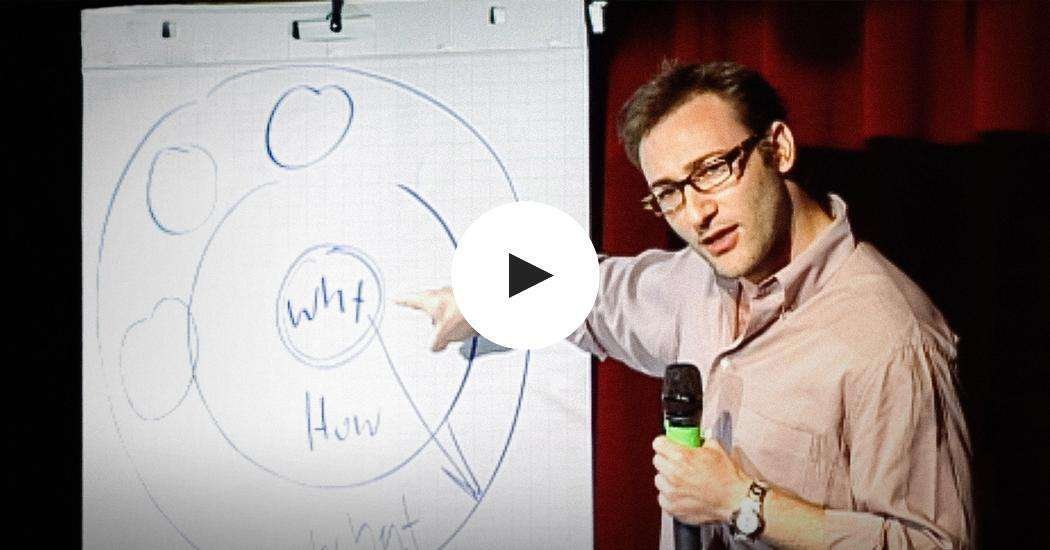
Simon Sinek’s video: how great leaders inspire action
Simon Sinek delivered this talk at TEDxPuget Sound in 2009. In roughly 18 minutes, he uses examples including Apple, Martin Luther King Jr. and the Wright brothers to explain why some people and organisations are able to generate trust, participation and action.
The video lasts approximately 18 minutes. In the sections below, you will find a summary of the model, practical applications and a critical view of its limitations.
Who Simon Sinek is and why this talk became so well known
Simon Sinek is an author and speaker whose work focuses mainly on leadership, organisational culture and motivation. He is best known for the concept of Start With Why, developed in the book of the same name and popularised through the talk How Great Leaders Inspire Action.
The talk’s success also comes from the simplicity of the model. Sinek begins with an observation: almost every company can describe what it sells; many can explain how they work; very few can clearly express why they exist and why people should care about their work.
He represents this difference through three concentric circles: Why, How and What.
What is Simon Sinek’s Golden Circle?
The Golden Circle is a model describing three levels of an organisation’s communication and identity:
- Why: why we exist and which cause, belief or change guides our work;
- How: how we translate that principle into methods, behaviours and distinctive qualities;
- What: what we actually create, including our products, services and activities.
According to Sinek, most organisations communicate from the outside in. They start with What, may continue with How and often never reach Why.
Organisations that inspire would follow the opposite path. They communicate from the inside out: they start with Why, show how they make it real and only then present what they offer.
Why: why does the company really exist?
The Why is not revenue, growth or profit. These are necessary outcomes for the survival of a business, but they are not the reason customers and employees should identify with its project.
A company’s Why may express:
- a change it wants to create;
- a problem it believes is important to solve;
- a belief that guides decisions;
- a different way of interpreting its industry;
- a value it wants to make tangible for a specific audience.
A strong Why should not sound like a motivational line copied from a corporate presentation. It should help the organisation make decisions.
If a company says it wants to make technology accessible, for example, that principle should influence pricing, product design, customer support, language and the overall experience. Otherwise, it remains only a slogan.
The Why is not a sentence to invent in a meeting
Many companies try to find their Why by starting with copywriting. They call a meeting, collect words such as innovation, quality and passion, and build a statement generic enough to belong to almost anyone.
The process should work in the opposite direction.
The Why should be found in the company’s history, its difficult choices, the customers it has decided to serve, the problems it solves best and the principles it refuses to sacrifice. The copy comes later: its role is to make something that already exists easier to understand.
How: how the promise is kept
The How represents the way an organisation brings its Why into reality.
It may include:
- its working method;
- the criteria used to make decisions;
- internal processes;
- distinctive capabilities;
- the model used to manage customer relationships;
- the standards the company commits to maintaining;
- the culture used to lead and develop people.
The How matters because it connects intentions with facts.
A company may claim to believe in simplicity, but if it forces customers through confusing and unnecessarily long procedures, it does not have a communication problem. It has a consistency problem.
Likewise, saying that the customer comes first means very little when support, contracts and internal processes are designed only around the convenience of the organisation.
The real How can be observed. It does not live only on the About Us page: it can be seen in how the product is designed, how the team works and how the company responds when something goes wrong.
What: what the company sells and delivers
The What is the easiest level to identify. It includes products, services, features and concrete activities.
This is also where one of the most common misunderstandings of the Golden Circle begins: the idea that What matters very little.
The product matters enormously. The Why can attract attention and create identification, but the product must solve a real problem. The service must work. The price must make sense. The experience must deliver what the communication promises.
Sinek himself has clarified that Why, How and What must work together: the Why opens a relationship and creates context, but it does not automatically close a sale.
A company with an inspiring purpose and a mediocre offer is still a company with a mediocre offer.
Apple as an example of the Golden Circle
In the talk, Sinek uses Apple to compare two different ways of communicating.
A traditional message might begin with the product:
We make well-designed computers that are easy to use and technologically advanced.
A message that starts with Why, on the other hand, places a belief at the centre: challenging convention and thinking differently. The product becomes the concrete expression of that principle.
The point is not to copy Apple’s language or turn every company into a cultural movement. The point is to understand that a product gains stronger meaning when it is connected to a recognisable and consistent vision.
That vision, however, must be supported by the experience. Without quality, design, ecosystem, distribution and operational capability, the Why would not be enough.
Martin Luther King Jr. and the Wright brothers
Sinek also uses Martin Luther King Jr. and the Wright brothers to argue that resources, formal authority and technical expertise alone do not explain the ability to mobilise people.
In the case of Martin Luther King Jr., the message was not limited to a list of political measures. It expressed a belief that other people could identify with and were willing to act upon.
In the case of the Wright brothers, Sinek contrasts their determination with apparently better-funded and better-organised groups. The example is intended to show how a shared belief can encourage perseverance and collaboration.
These cases work well as storytelling. They should, however, be treated as examples that help explain a model, not as scientific proof that Why is the single cause of success.
What the Golden Circle teaches marketing
Marketing often begins with what the company wants to sell:
- product features;
- years of experience;
- service quality;
- the technology being used;
- the value or convenience of the offer.
These are important pieces of information, but they are rarely enough to build a strong position in the market.
The Golden Circle forces the organisation to connect its offer to a broader idea:
- which problem do we want to help solve?
- for which people or companies?
- why do we believe that problem matters?
- what do we do differently?
- what evidence shows that we are not simply telling a compelling story?
This approach can create greater consistency across a company’s marketing strategy, website, sales communication, content and the way its offer is presented.
It does not mean removing data, features or benefits. It means placing them inside a narrative that helps the audience understand not only what is being sold, but what kind of choice it represents.
Golden Circle and leadership: the Why must guide the team too
The model is not only about how a company communicates with customers.
A clear Why can help people understand:
- how their work contributes to a wider outcome;
- which decisions are consistent with the organisation’s identity;
- why certain priorities are chosen while others are excluded;
- which behaviours are genuinely rewarded;
- what should not be sacrificed even when doing so would be more convenient.
But this also requires concrete action. Purpose does not compensate for poor organisation, inconsistent leadership or a lack of trust.
If a company speaks about people and collaboration but rewards only individual results achieved at any cost, the message loses credibility. Real culture is determined mainly by the behaviours that are tolerated and the decisions that are made, not by words displayed on a wall.
Where the Golden Circle can become too simplistic
The Golden Circle is powerful precisely because it is simple. Its simplicity, however, can also become its limitation.
The Why does not automatically create demand
A company can have an authentic purpose and still operate in a market that is too small, unprofitable or unwilling to pay.
Understanding the audience comes before communication. The company must define its target market, analyse real problems and verify that sufficient demand exists.
The Why does not replace positioning
Two companies may share similar values and compete in the same sector. To be chosen, a business must also clarify who it is best suited to serve, which problem it solves better and why its proposition is different from the alternatives.
The Why cannot save a weak product
People may be attracted by a story, but they stay when the product keeps its promise.
A strong identity can amplify a good product. It cannot turn a disappointing experience into sustainable success.
The Why can become purpose washing
When the gap between declarations and behaviour becomes too wide, purpose has the opposite effect: it increases distrust.
Companies do not need to appear perfect. They do, however, need to show that their choices are at least moving in the direction they claim to support.
A note on the neuroscience explanation
In the talk, Sinek connects What with the neocortex and Why with the limbic system, associating the latter with emotion, trust, loyalty and behaviour.
It is an effective explanatory metaphor, but it should not be interpreted as a complete representation of how the brain works.
Contemporary neuroscience describes emotion, cognition and decision-making as interdependent processes involving distributed networks of cortical and subcortical areas. The limbic system is not simply an “emotional centre” separated from a rational part of the brain.
This clarification does not remove the practical value of the Golden Circle. It does, however, help distinguish a useful communication model from a definitive neuroscientific explanation.
My practical evolution: Who, Why, How, What and Proof
To apply the Golden Circle to a small or medium-sized business or a marketing project, I would add two elements: Who and Proof.
WHO → WHY → HOW → WHAT → PROOF
Who: who do we exist for?
Before discussing Why, we need to understand who we want to create value for.
A purpose that is too broad may sound noble, but it rarely helps build an effective offer. Identifying the audience forces the company to choose which problems it wants to address and which people are not its priority.
Why: which change do we want to create?
This is the belief that guides the project and explains why the problem deserves to be solved.
How: how do we keep the promise?
These are the methods, processes, principles and qualities that make the approach recognisable.
What: what do we actually offer?
This is the product or service through which value is delivered.
Proof: why should people believe us?
Evidence may include:
- results achieved;
- case studies;
- reviews and testimonials;
- verifiable data;
- product demonstrations;
- documented experience;
- transparent methods and processes.
Proof is essential because it turns a promise into credibility.
An example applied to Web Marketing Aziendale
A description that starts only with What might read:
We create SEO strategies, advertising campaigns, lead generation projects, automations and artificial intelligence solutions.
It is accurate, but it mainly describes what we do. It does not explain which vision connects such different activities.
Using the extended model:
Who
Companies that want to turn digital marketing into a more measurable system that is less dependent on isolated activities.
Why
We believe marketing and technology should contribute to concrete business results, rather than producing only traffic, impressions or presentations filled with decorative metrics.
How
We connect strategy, acquisition, data, content, automation and the development of proprietary tools.
What
Consulting, SEO, advertising, lead generation, e-commerce, artificial intelligence and SaaS platforms.
Proof
Experience developed since 2008, projects delivered across different industries, campaigns managed, tools developed and results that can be documented.
This structure is not useful only for writing a better company presentation. It also helps identify which services are consistent with the project, which customers can receive the greatest value and which forms of evidence need to become more visible.
How to find your company’s Why
The Why does not emerge from a thirty-minute creative session. It can, however, be discovered by asking several concrete questions.
1. Why was the company really created?
Do not stop at the legal or financial answer. Which problem, frustration or opportunity led to its creation?
2. Which projects have been the most satisfying?
Identify the work in which the company expressed its capabilities and way of operating most effectively.
3. Which problems do we naturally choose to address?
Recurring priorities often reveal what the organisation genuinely considers important.
4. Which principles are we unwilling to sacrifice?
A value becomes real when it requires a choice and, sometimes, a cost.
5. What would change for the customer if we did our best work?
This question shifts attention from the activity being performed to the impact being created.
6. Do our decisions support what we claim?
Review pricing, processes, customer support, communication, team management and the quality of the experience.
7. What evidence makes our Why credible?
If the evidence is missing, the next step is not to write a more persuasive slogan. It is to build the evidence.
Exercise
Complete this sentence: “We help [who] achieve [change], because we believe [belief]. We do this through [method] and demonstrate it with [proof].”
Is the Golden Circle still useful?
Yes, provided it is used as a tool for clarity rather than as a motivational shortcut.
The Golden Circle is useful when it helps a company:
- connect strategy and communication;
- make its positioning more recognisable;
- align decisions and behaviours;
- explain the value of its offer more clearly;
- build a more credible relationship with customers and employees.
It becomes weak when it is reduced to an ambitious sentence that does not change products, processes or choices.
The most important point in Sinek’s message is not that companies should speak less about what they sell. It is that What becomes more powerful when people understand Why, recognise How and see concrete Proof.
Conclusion: start with Why, but do not stop at Why
When I published this video in 2013, I mainly saw its message as an invitation to communicate differently.
Today, I also see it as a useful way to assess the consistency of an organisation.
Why can provide direction. How turns that direction into behaviour. What creates concrete value. Proof makes the whole system credible.
This is the sequence that allows an idea to move beyond rhetoric:
it is not enough to declare what we believe; we must build an organisation capable of proving it.
Frequently asked questions about the Golden Circle
What is Simon Sinek’s Golden Circle?
It is a model built around three concentric levels: Why, How and What. It suggests beginning with the reason an organisation exists, explaining how that principle is made concrete and finally presenting what the organisation offers.
What is the difference between Why, How and What?
Why represents purpose, cause or belief. How includes methods, behaviours and distinctive qualities. What refers to products, services and concrete activities.
Can profit be a company’s Why?
In Sinek’s model, profit is a necessary result rather than the Why. The Why should express the change or principle that guides the organisation.
Does the Golden Circle work for small businesses?
Yes. It can help a small or medium-sized company clarify its positioning, create more consistent communication and connect its offer, processes and customer needs more effectively. It must still be supported by market analysis and concrete evidence.
Is starting with Why enough to sell?
No. Why can create attention and identification, but selling requires a valid offer, a suitable audience, clear positioning, sustainable pricing and the ability to keep the promise.
Sources and further reading
Condividi questa storia, scegli tu dove!




About the Author: Gentian Hajdaraj