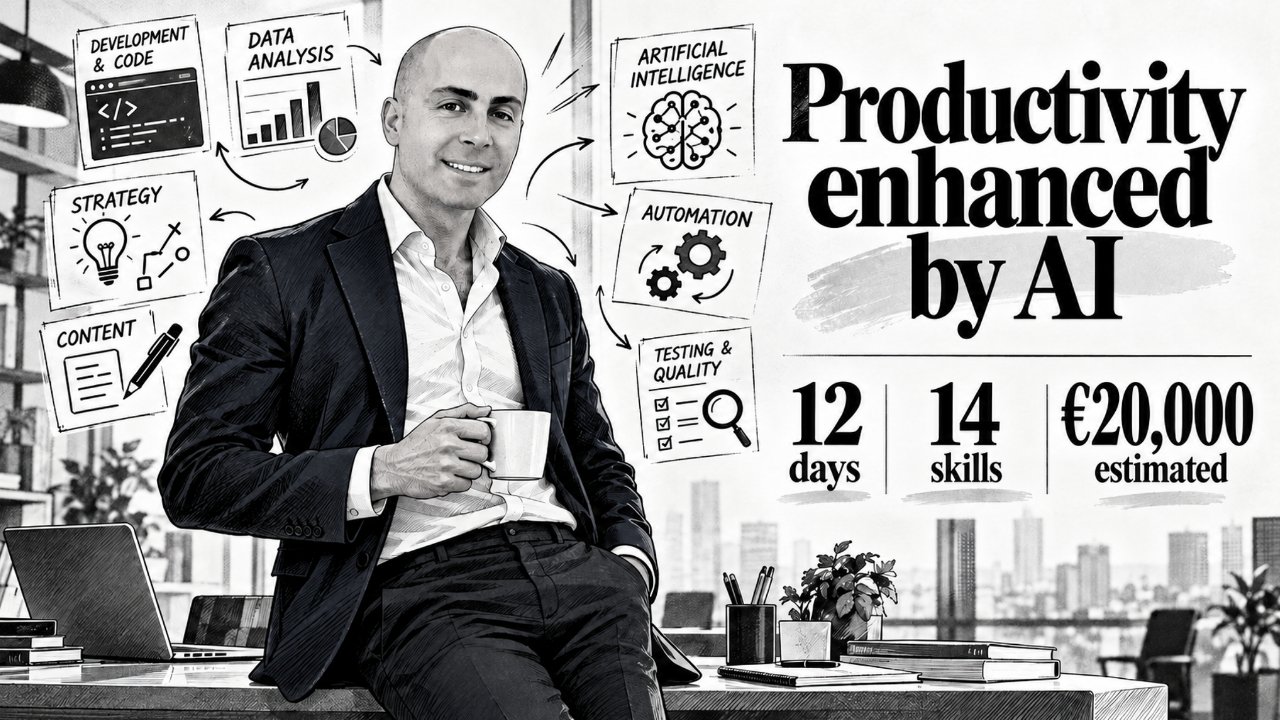
In 12 Days, I Worked Across 14 Professional Roles. Estimated Value: €20,000. Here’s What AI Changes.
A real AI productivity experiment: 12 days, 14 professional disciplines, and an estimated €20,000 in equivalent work. The lessons for skills, quality, and time.

Indice dei contenuti
A real-world experiment in AI-augmented productivity. Not an attempt to prove that people are replaceable, but an exploration of how AI is changing the value of work, professional skills, and the relationship between time and results.
Over the past 12 days, I carried out an experiment. Or rather, it wasn’t intended to be one: I only realized what had happened when I started looking back at everything I’d accomplished.
I worked on software development, AI architectures, data analysis, automation, marketing, SEO, digital product design, testing, and strategy—all within the same period.
These are very different kinds of work. In a traditional organization, they would normally involve several specialized professionals.
At some point, I asked myself a question: How much would it have cost to outsource all this work to a team of professionals?
I reconstructed the activities, identified the skills involved, and estimated how long qualified specialists might have taken to produce comparable results.
- 12 elapsed days analyzed, from October 1 to October 13, 2026.
- 14 professional disciplines involved, defined as areas of expertise.
- Approximately €20,000 in estimated equivalent professional costs.
- 181–328 hours of estimated outsourced work across different scenarios.
This is not €20,000 earned. It isn’t necessarily €20,000 saved, either. And it doesn’t mean I replaced 14 full-time employees.
It’s an estimate of what a company might have paid external professionals to perform a comparable set of tasks. But the most interesting part isn’t the amount of money. It’s what the experience taught me about how work is changing.
I didn’t replace 14 people. I worked across 14 disciplines.
Let’s start with an important distinction, especially at a time when AI productivity is often described through sensational headlines.
Working across 14 professional disciplines is not the same as producing the output of 14 full-time employees.
It means being able to tackle challenges that span different fields without having to bring in a different specialist for every individual step.
During the period I analyzed, my activities touched on the following areas:
| Professional role | Area of work |
|---|---|
| Software Architect | Software architecture and integrations |
| AI Engineer | AI systems, models and workflows |
| Backend Developer | Application logic, features and APIs |
| Data Engineer | Data processing, normalization and management |
| DevOps Engineer | Release automation and development infrastructure |
| QA Engineer | Testing, quality assurance and error detection |
| Product Manager | Feature definition and development priorities |
| Growth Strategist | Growth strategies and commercial opportunities |
| SEO Specialist | Search optimization and visibility analysis |
| Advertising Specialist | Advertising campaign analysis and optimization |
| Marketing Automation Specialist | Process integrations and automation |
| Data Analyst | Data analysis and interpretation |
| Content Strategist | Content planning and development |
| UX/UI Designer | Interface and user experience design |
This doesn’t mean I performed every one of these jobs at the same depth as someone who has devoted an entire career to it. It means I could combine cross-disciplinary knowledge, experience, and AI tools to complete work that normally crosses those boundaries.
My initial reconstruction suggested that an external team might have needed 181–328 hours. Spread over nine eight-hour working days in the same calendar period, that corresponds to roughly 2.5–4.6 full-time equivalents.
The important difference isn’t the headcount. It’s the ability to bring different capabilities together within one continuous decision-making process.
The real shift isn’t simply doing things faster
For years, we’ve mainly thought of artificial intelligence as a way to automate tasks: write faster, analyze a document, generate code, summarize research, or prepare a presentation.
All of these uses matter. But I think they only capture a small part of the change underway.
The more interesting transformation happens when AI enables one person to work across disciplines that previously required handoffs between specialists.
A business need can become a functional specification, turn into code, be tested, integrated, and ultimately used to improve an actual process. This is the move from standalone AI tools to business workflows, all within a more connected stream of work.
Consider digital product development. Someone identifies a requirement. An analyst translates it into specifications. An architect designs the solution. A developer implements it. A tester checks it. Someone else handles deployment.
Each handoff brings communication, coordination, and often waiting time.
With AI, a meaningful share of those steps can be handled with greater continuity. That doesn’t remove the need for specialists or quality controls. It reduces the interruptions between stages.
In some situations, those reduced handoffs may matter even more than the speed of the individual tasks.
How I estimated the €20,000
Rather than turning a personal experience into an unsupported claim, I tried to estimate the economic value of the work performed.
My approach was to identify the activities, distinguish completed deliverables from ideas and unfinished experiments, identify the professional expertise involved, estimate equivalent outsourced hours, and apply different rates according to the work’s complexity and specialization.
The result was three scenarios:
| Scenario | Estimated external cost |
|---|---|
| Conservative | Approximately €10,000 |
| Central estimate | Approximately €20,000 |
| Higher-end | Approximately €31,000 |
The €20,000 figure is therefore a central scenario, not a measured accounting result.
The range is wide for practical reasons. Different developers can take very different amounts of time to deliver the same feature. Agencies and freelancers charge different rates. Some assignments require more architecture, validation, or integration work than others.
Nor would every organization necessarily outsource every activity included in the estimate.
It would be misleading to present this figure as an independent valuation or an actual saving recorded in financial accounts. Still, it provides a useful indication of the scale of productive capacity that AI can make accessible.
And it raises a more interesting question: What happens to the value of a professional when their ability to execute increases so dramatically?
Artificial intelligence doesn’t eliminate the need for expertise
There’s something I believe we overlook too often.
AI can write code—but you still need to know whether that code solves the problem. It can suggest a strategy—but you still have to judge whether that strategy makes economic sense. It can process data—but sources and conclusions must be checked.
AI can propose a software architecture, but someone needs to understand the consequences, identify risks, and take responsibility for the outcome.
Artificial intelligence doesn’t automatically turn an inexperienced person into a senior professional. One of the biggest risks is getting an output that looks convincing without having the knowledge to spot its flaws.
Execution has become more accessible. Judgment is still essential.
After years working in digital business, one of the biggest differences I notice isn’t just that I can get an answer or produce a result faster. It’s that experience helps me recognize unnecessarily complicated solutions, missing steps, and problems that haven’t been framed correctly.
AI accelerates many activities. Deciding which activities are worth accelerating remains a human responsibility. The same principle applies to AI in marketing.
The biggest advantage is connecting different skills
Imagine two scenarios.
In the first, a company wants to build a new digital feature. The request moves between marketing, product management, technical leadership, development, quality assurance, and deployment. Even when everyone does an excellent job, this process requires handoffs and reviews.
In the second, a professional with cross-functional experience uses AI to coordinate a substantial part of the process, bringing in specialists when deeper expertise, independent checks, or specific accountability is needed.
The second approach isn’t always the right one. Critical systems, highly complex projects, and regulated environments often need structured teams and clear separation of responsibilities.
But for many experiments and digital-product initiatives, it can significantly shorten the path between an idea and something that can actually be used.
AI doesn’t just lower the cost of individual tasks. It can lower the cost of testing new ideas.
An entrepreneur can validate a hypothesis more quickly. A consultant can build internal tools to improve services. A small company can develop solutions it previously would have needed to purchase or outsource.
That doesn’t mean every idea will succeed. It means more ideas become affordable to explore.
There’s a risk, too: producing more without creating value
This may be one of the most important lessons I took away from the experience.
If AI enables us to produce substantially more, it doesn’t automatically follow that we’ll generate more revenue, build a stronger business, or achieve better outcomes.
We can build features nobody uses. Create automations that solve low-priority problems. Publish content that contributes little knowledge or authority. Develop technically interesting products with no proven demand.
AI can make all of this faster and cheaper. But a pointless task doesn’t become valuable just because it takes only a few minutes.
In fact, when production becomes inexpensive, multiplying initiatives without evaluating their impact becomes even easier.
That’s why I believe one of the most valuable professional skills in the coming years will be knowing what not to build.
Productivity becomes a competitive advantage only when it serves a clear direction.
Productivity should improve quality of life, too
There’s another point I consider essential, and it’s often missing from discussions about AI and productivity:
Producing more shouldn’t automatically mean working more.
If I can complete a task in two hours instead of eight, I have choices. I can pursue another project, spend more time refining the result, improve its quality, or simply reclaim time for myself.
Those choices aren’t necessarily mutually exclusive.
Used well, AI can free us from repetitive work and allow us to devote more attention to activities that demand experience, creativity, empathy, and judgment.
Of course, speed doesn’t guarantee quality. A quickly generated result that hasn’t been verified may create more problems than it solves. Part of the time saved should go toward thinking, checking, and improving.
But there’s also something beyond work.
Time is probably the most valuable form of wealth we have. We can’t stockpile it, buy back yesterday, or recover the hours we’ve already lost.
More time with family, with the people we care about, to learn, travel, or simply live without filling every hour with obligations is an outcome no productivity metric can fully capture.
Perhaps the real success of AI won’t be enabling us to work like ten people. It will be enabling us to achieve better results without sacrificing all our time to get there.
From hands-on professional to orchestrator of capabilities
The shift I’m noticing in my own work is primarily about the professional’s role.
Traditionally, a person’s value was often tied to their ability to execute certain tasks directly: programming, analyzing data, running campaigns, designing interfaces.
Those skills will continue to matter. But a new dimension is emerging: the ability to orchestrate resources, tools, and different areas of expertise.
Understanding the problem, defining the intended outcome, breaking down complexity, coordinating AI tools and agents, evaluating outputs, and integrating them into a functioning system are becoming increasingly important.
A professional is no longer only the person who executes. They can also design, coordinate, verify, and improve the overall process.
That doesn’t mean everyone should become a generalist. Specialists remain indispensable where deep knowledge and professional accountability are needed.
But I expect the value of people who can connect disciplines and turn fragmented knowledge into real results to increase.
The skill of the future won’t just be knowing how to do something. It will be knowing what to do, why it matters, and how to verify that it works.
The question is no longer simply how many people we need
After these 12 days, I don’t think I’ve demonstrated that one person can replace an entire team.
I think I’ve observed something different: the relationship between headcount, work complexity, and productive capacity is changing.
For some activities, the benefits of AI will be modest. For others, they could be extraordinary. And they won’t be distributed equally. Skills, tools, processes, and—above all—the quality of decisions will make the difference.
For entrepreneurs, this creates opportunities to test services and products with smaller initial investments. For professionals, it offers a way to extend their reach and devote more attention to the parts of work where human experience truly matters.
But the principle remains: it’s not how many tasks we complete that counts. It’s what those tasks achieve.
The question I’m asking now isn’t simply how much more work I can do with AI. It’s this:
If I can produce substantially more with the same resources, how can I turn that capacity into products, services, and value that continue to grow over time?
Because the real promise of artificial intelligence shouldn’t be simply to make us work more.
It should help us build things we previously lacked the resources to create, improve the quality of our work, and—perhaps—give us some of our time back.
Ultimately, technology should work to improve our lives, not turn every minute of our lives into work.
Methodology note
This analysis covers activities reconstructed for October 1–13, 2026: 12 elapsed days between the start and end dates, not 12 complete working days. The 14 roles refer to professional disciplines involved, not 14 full-time employees.
The estimated 181–328 hours represent hypothetical time external professionals might have needed to achieve comparable results, not the hours I personally worked. The central estimate of approximately €20,000—with a broad illustrative range of €10,000–€31,000—comes from professional-cost scenarios rather than an independent valuation. Actual revenues, documented cost savings, and the potential future commercial value of products are excluded.
Condividi questa storia, scegli tu dove!




About the Author: Gentian Hajdaraj