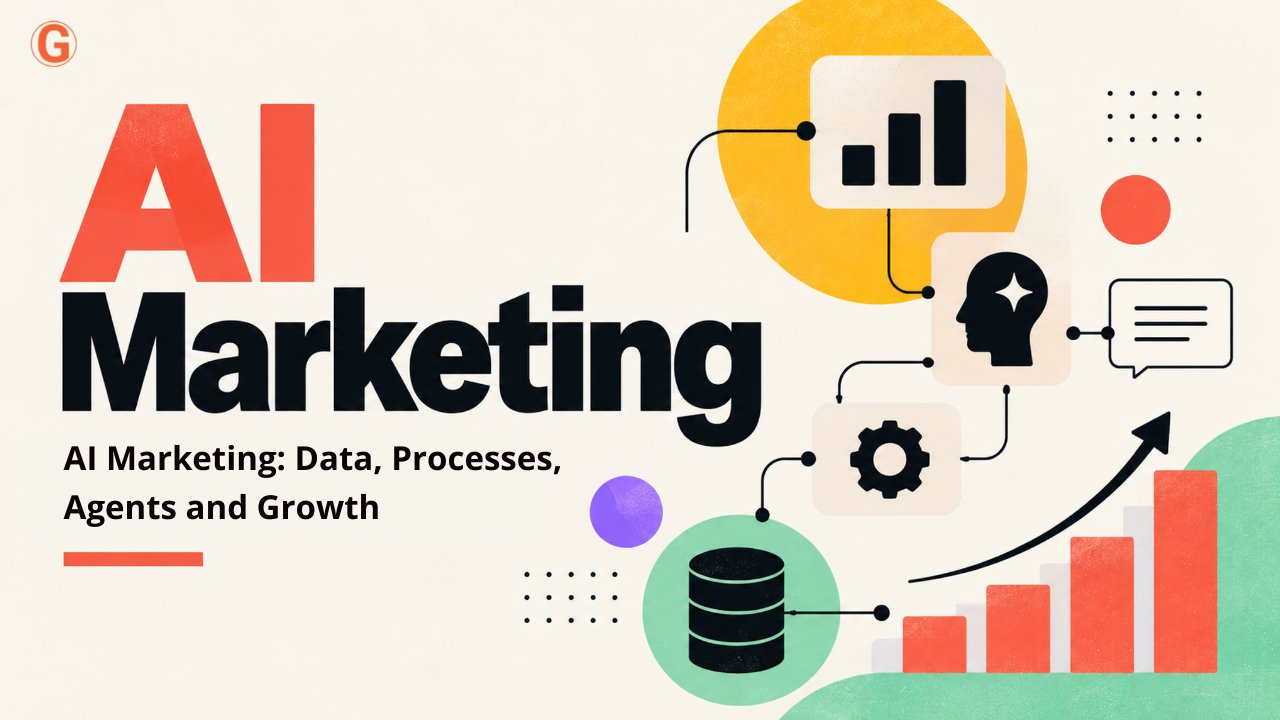
AI Marketing: How to Apply Artificial Intelligence to Marketing Processes
A practical guide to applying AI to marketing processes, data, agents, automation, decision-making and AI Search.

Indice dei contenuti
In short: AI marketing is not about adding ChatGPT or a few automations to what a team already does. It becomes useful when it improves a decision, removes a manual step, makes data easier to interpret, or increases operating capacity without losing control. The starting point, therefore, is not choosing a tool. It is understanding which part of the marketing process is worth redesigning.
Artificial intelligence now touches almost every area of marketing: research, content, advertising, CRM, email, analytics, customer experience and automation. That creates a huge number of possibilities, but also a new problem: it is now very easy to do more without necessarily producing a better result.
The complexity is not theoretical. IAB Italia reported that more than 2,300 generative-AI marketing tools had already been mapped by 2024, and argued that the real challenge for companies is integrating them into processes rather than simply adopting them. That distinction matters: as tools become abundant, competitive advantage shifts from access to technology to the quality of the system in which the technology is used. Source: IAB Italia.
This is why I see AI marketing primarily as a design problem. Strategy comes first, then the process, then the data, and only after that the model or tool. It is the same principle I use when working on marketing strategy: technology amplifies what is already there, so a confused process can easily become a confused process that simply runs faster.
What is AI marketing?
By AI marketing, I mean the application of artificial intelligence systems to marketing activities and decisions in order to improve analysis, production, personalization, automation and responsiveness.
The definition is intentionally broad. It includes very different technologies: generative models, machine learning, recommendation systems, classification, semantic search, AI agents, computer vision and automated workflows. But from a business perspective, the technical distinction matters less than a much more practical question: which outcome becomes better because of AI?
Writing a piece of copy faster is an operational benefit. Identifying which customers are more likely to buy, detecting emerging demand before competitors, or qualifying hundreds of requests more accurately are system-level changes. Those are usually the cases where AI creates the most interesting value.
The most common mistake: starting with the tool
The typical path looks like this: a new tool launches, someone tests it, the team searches for tasks to apply it to, and only afterwards tries to understand whether it created value. I prefer to reverse that order.
I start with four elements:
- Decision: which decision do we want to make better or faster?
- Process: which steps currently consume time, introduce errors or slow the outcome?
- Data: which information do we already have, and what is missing?
- Control: which activities can be delegated, and which must remain under human responsibility?
Only after that does it make sense to decide whether we need a generative model, an agent, automated classification, a retrieval system or a conventional automation. This is consistent with my working method: first understand where to intervene, then decide what to build.
Where artificial intelligence creates value in marketing
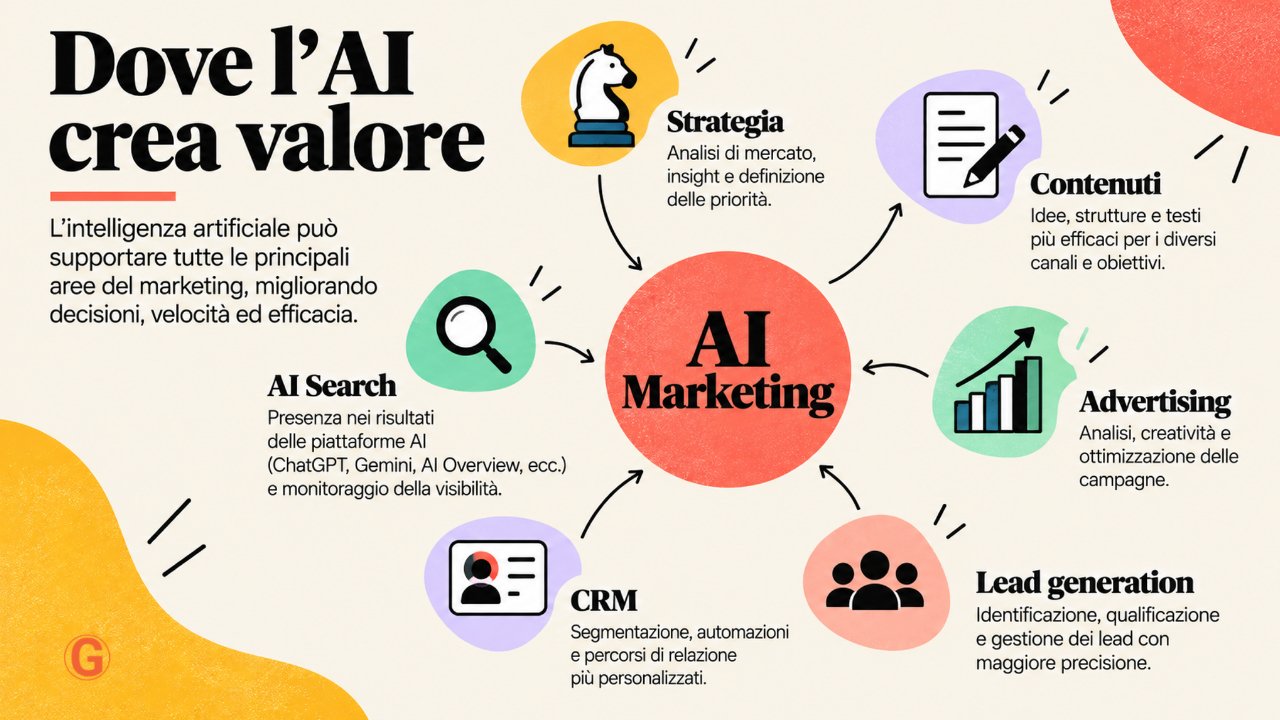
AI creates value when it improves a process or a decision, not when it is added as an isolated tool.
1. Market intelligence and demand analysis
Before producing content or campaigns, AI can help a team read the market. That means aggregating signals, classifying queries and intents, comparing competitors, summarizing reviews, detecting patterns and surfacing changes in demand.
This is one of the reasons I developed Telescop: to connect keywords, intent, competition, demand and brand visibility inside one intelligence system. The platform now works with more than 1.5 million classified intents, a scale that makes one thing obvious: the problem is no longer collecting more data, but turning that data into readable signals. Here AI is not mainly used to “write.” It is used to reduce the distance between large volumes of data and an actionable decision.
2. Research, segmentation and customer understanding
Many teams already hold more customer information than they can realistically use: sales notes, conversations, support tickets, form responses, emails, reviews, CRM records and analytics data. Language models and classification systems can turn that mass of information into segments, recurring themes, objections and intent signals.
The point is not to manufacture an artificial buyer persona. It is to reach a more granular understanding of the problems people are actually expressing.
3. Content marketing and production
Content generation is the most visible use of AI, but also one of the easiest areas in which to create noise. A model can accelerate preliminary research, outlining, variations, editing and repurposing. What it cannot decide on its own is what is actually worth saying.
Content becomes much more useful when AI starts from proprietary material: data, interviews, case studies, experiments, knowledge bases, documentation and first-hand observations. In that case, the model amplifies real knowledge. When it starts only from a generic prompt, it tends to reproduce the same statistical average available to everyone else.
4. Advertising
Advertising platforms have used machine learning for years across bidding, audiences, attribution and creative optimization. Generative AI adds another layer: research, search-query analysis, creative ideation, ad variations, result summaries and decision support.
The principle remains the same: delegating production is not the same as delegating strategy. In my guide to using ChatGPT for Google Ads campaigns, I make that distinction explicit. AI can become an effective copilot, but budgets, objectives, unit economics and data quality remain the team’s responsibility.
5. Lead generation and qualification
In lead generation, AI can intervene before, during and after conversion: understanding intent, adapting questions, summarizing a request, classifying a lead, enriching it and preparing the next follow-up.
This shifts attention from the number of form submissions to the quality of the opportunity. That matters particularly in B2B, where a small number of well-qualified enquiries can be worth far more than a large volume of generic contacts. The B2B lead generation statistics help explain why the process cannot be reduced to simply collecting a name and email address.
6. CRM, customer experience and email
Once a contact has been acquired, AI can help interpret history, prepare responses, identify priorities, suggest next-best actions and personalize communication based on context. The quality of the result depends heavily on the knowledge available to the system.
An assistant connected to company data can be useful. An isolated chatbot that only knows its initial prompt rarely changes the process in a meaningful way.
7. Analytics and decision support
One of the applications I find most interesting is using AI as an interrogation layer over company data and knowledge. Not just dashboards that display numbers, but systems that help formulate questions: what is changing? where are we losing opportunities? which segment is behaving differently? which campaigns deserve attention?
The value is not receiving an answer in natural language. The value is reducing the time between a signal and a decision.
From generation to AI agents
A generative model responds. An AI agent, by contrast, can use tools, consult sources, maintain state, execute multiple steps and produce an operational result. That is an important shift because it moves AI from content generation into the workflow itself.
In marketing, an agent might collect information about a prospect, compare it with CRM data, prepare a summary, suggest a priority and draft a follow-up. Or it might periodically inspect a set of market signals and surface changes that require attention.
This is the area I am exploring with Quantiq: bringing company knowledge, assistance and agents into real business processes, instead of leaving AI in a separate window beside the actual work.
AI Search: marketing no longer happens only on Google
Artificial intelligence is also changing where people discover and evaluate companies, products and sources. A growing part of discovery and consideration now happens through ChatGPT, Gemini, Google AI Overviews, AI Mode and other generative experiences.
This creates a new marketing problem: it is no longer enough to know whether a website ranks well. It becomes useful to understand whether a brand is mentioned, recommended and cited in AI-generated answers, alongside which competitors and through which sources.
This is the field of AI Search Visibility. With Telescop I built a dedicated observation system and the research project AI Search Visibility in Italy 2026: 500 Italian queries observed across ChatGPT, Gemini, Google AI Overview and AI Mode in three complete and separate runs, for 6,000 final observations. One conclusion is especially important: there is no single form of “AI visibility.” Presence, recommendation, citation and competitive share describe different phenomena.
For a marketing team, that means adding a new surface to the distribution strategy. Search and AI Search should be observed together, without treating them as the same thing.
A practical framework: Task → Process → Data → AI
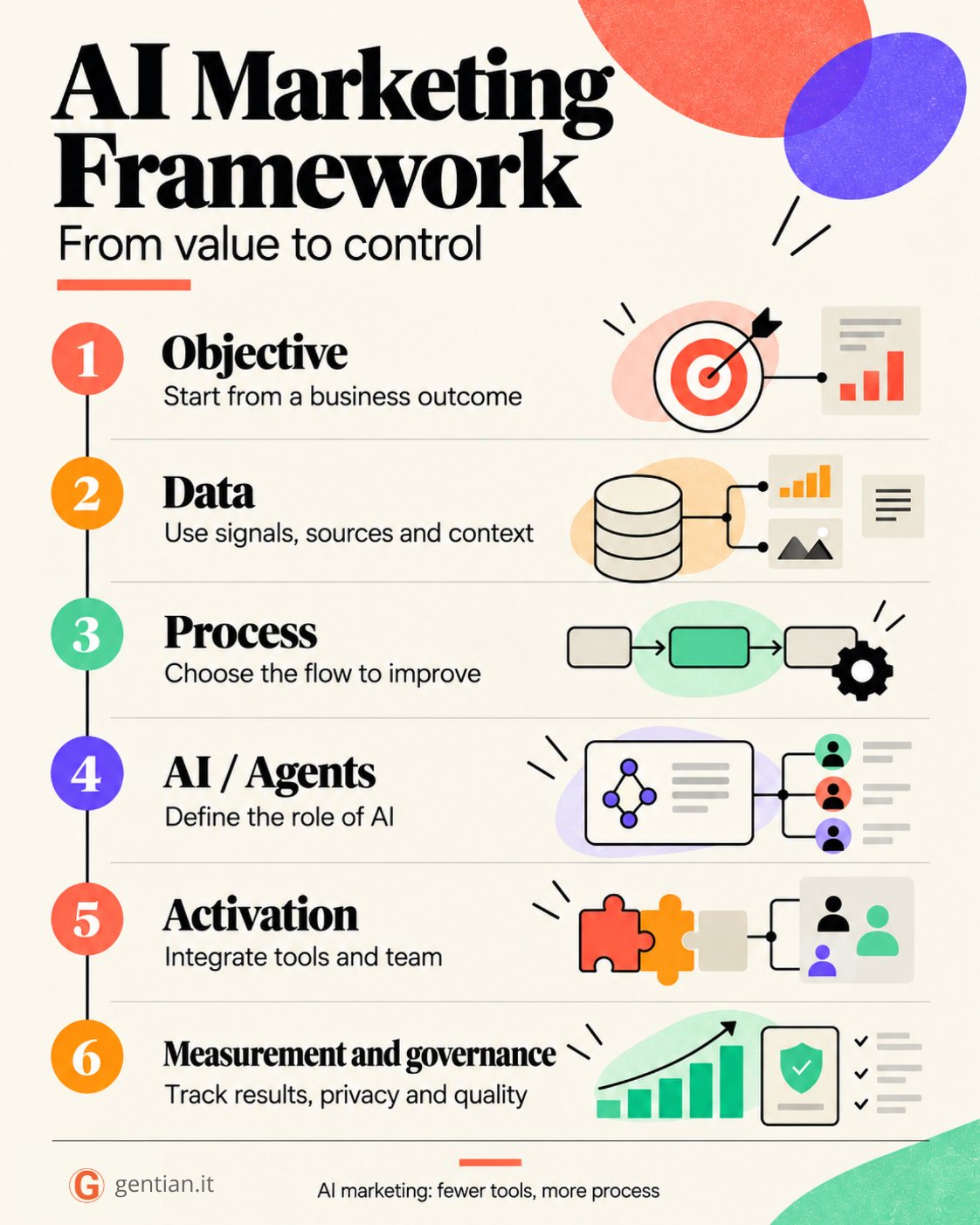
AI Marketing framework by Gentian Hajdaraj: Task → Process → Data → AI
When I evaluate an AI marketing use case, I use a very simple sequence.
Task
Which specific activity do we want to improve? I avoid vague goals such as “use AI in marketing.” Better examples are: classify enquiries, summarize insights, produce variants, retrieve information or prioritize leads.
Process
Where does that task sit inside the complete workflow? If we automate a step that is not the real bottleneck, the overall result changes very little.
Data
Which information is required to perform the work well? AI does not automatically compensate for missing, inconsistent or unreliable data.
AI
Only at this point do we choose the solution: prompt, model, retrieval, workflow, agent or conventional automation. Sometimes the best answer does not require an LLM at all.
Governance: data, privacy, transparency and human control
Integrating AI into a marketing process also means deciding which data the system can use, which actions it can perform, what should be logged, and where human intervention is required. The closer a system gets to customers, personal data, public communication or operational decisions, the more these questions should be designed together with the workflow rather than added at the end.
In the European Union, the AI Act follows a risk-based approach and introduces specific transparency requirements for certain systems and content. The Commission’s guidance around Article 50 transparency obligations applies from 2 August 2026. That does not mean every marketing automation is “high risk.” It does mean that governance, traceability, security, transparency and human oversight cannot be ignored when the use case makes them relevant. AI Act — European Commission.
When I would NOT use AI
Not every activity improves by adding artificial intelligence. I would be particularly cautious when:
- the underlying process is not yet clear;
- the required data does not exist or is not reliable;
- a simple deterministic rule already solves the problem well;
- the cost of verification is higher than the time saved;
- the decision requires human accountability and automation adds no real advantage;
- the only objective is “to do something with AI.”
This selectivity matters. Effective AI marketing is not the marketing system with the most AI. It is the one in which AI positively changes the outcome.
How to start inside a company without turning everything into an endless project
A practical adoption path can be divided into three levels.
Level 1 — Copilot
AI assists a person with research, summarization, drafting or preliminary analysis. This is the easiest level to test and the one with the fewest technical dependencies.
Level 2 — Workflow
AI becomes part of a repeatable process: it receives data, applies rules and models, produces an output and passes the result to the next step. At this stage, integrations, data quality and monitoring begin to matter much more.
Level 3 — Agent
The system manages a sequence of activities, uses tools and makes decisions within defined limits. This has greater potential, but also requires more attention to control, observability and fallback mechanisms.
In many cases, Level 1 or Level 2 already produces a meaningful return. Not every process needs to become an agent.
How to measure whether AI marketing is working
I would measure the effect on the process metric, not the amount of AI being used. Useful examples include:
- average time required to complete a task;
- cost per useful output;
- percentage of leads correctly qualified;
- time between acquisition and follow-up;
- conversion rate or pipeline generated;
- number of errors or revisions required;
- time needed to reach an insight;
- increase in coverage without a proportional increase in human workload.
“We produced 500 pieces of content with AI” is not a KPI. It is an activity count.
My view of AI marketing
I have worked in digital since 2008 and have seen several technology waves reshape tools and behaviour: social, mobile, programmatic advertising, marketing automation, SaaS, and now generative and agentic AI. Each time, there is a temptation to assign strategic intelligence to the technology itself.
For me, the advantage of AI is not that it eliminates marketing. It is that it can increase an organization’s ability to understand, decide and execute when the surrounding system is designed well.
That is why the projects I am building address different parts of the same problem: Telescop observes demand, intent, competitors and AI Visibility; Quantiq brings AI and agents into processes; Primeforms focuses on the quality of data capture and lead qualification; Woomail on relationship and automation; and Socialtrust on trust signals before conversion.
These are not simply “AI tools” placed next to one another. They are different ways of working on the same chain: understanding the market better, making better decisions, and turning those decisions into usable processes.
Experience, projects and sources behind this analysis
- Direct experience: working in digital since 2008 and founding Web Marketing Aziendale in 2012.
- Related products: Telescop, Quantiq, Primeforms, Woomail and Socialtrust.
- Original research: AI Search Visibility in Italy 2026, 500 queries × 4 AI surfaces × 3 runs, for 6,000 final observations.
- Dataset and methodology: DOI 10.5281/zenodo.22640375.
- Approach: start with the objective, process and data before choosing tools or models.
- Industry context: the IAB Italia Artificial Intelligence White Paper emphasizes process integration, strategic and technical prerequisites, and legal and ethical considerations.
Last updated: September 28, 2026.
Frequently asked questions about AI marketing
What is the difference between AI marketing and marketing automation?
Marketing automation mainly executes workflows and rules defined in advance. AI can add language understanding, classification, prediction, generation and decision support. In practice, the two often work together.
Can AI replace a marketing team?
AI can automate or accelerate many activities, but strategy, accountability, contextual knowledge and economic judgement remain human responsibilities. The more realistic change is a team that increases its capacity through AI.
What is the first marketing process to automate with AI?
There is no universal answer. A good starting point is a frequent and measurable activity with reasonably structured inputs and a visible operating cost. That makes the result of the experiment easier to evaluate.
Is ChatGPT enough for AI marketing?
ChatGPT is a powerful tool, but AI marketing is a broader concept. It can involve company data, integrations, search systems, classification, agents, multiple models and automations that do not necessarily run through ChatGPT.
What are AI agents in marketing?
They are systems that can manage multiple steps, use tools and sources, and produce an operational result within defined rules. They can be applied to research, lead management, CRM, sales support, analytics and other workflows.
Are AI Search and AI marketing the same thing?
No. AI Search concerns how brands, products and sources appear inside AI-based search and answer experiences. It is a new discovery and consideration surface within marketing strategy, but it does not represent the whole field of AI marketing.
Conclusion
AI marketing becomes interesting when it stops being a collection of tools and becomes a designed part of the growth system. Before asking which model to use, it is better to ask which decision, task or process is currently limiting the result.
If that point is clear, AI can increase speed, capacity and quality. If it is not, it will probably just produce more output.
AI Marketing and AI Search Visibility
AI Marketing increasingly includes another question: how brands and sources are represented inside generated answers. I cover the measurement side in my guide to AI Search Visibility, GEO and LLM SEO, including presence, recommendations, citations, source intelligence, and cross-surface measurement.
Condividi questa storia, scegli tu dove!




About the Author: Gentian Hajdaraj