AI Search Visibility in Italy 2026: the Book Born from Telescop Research
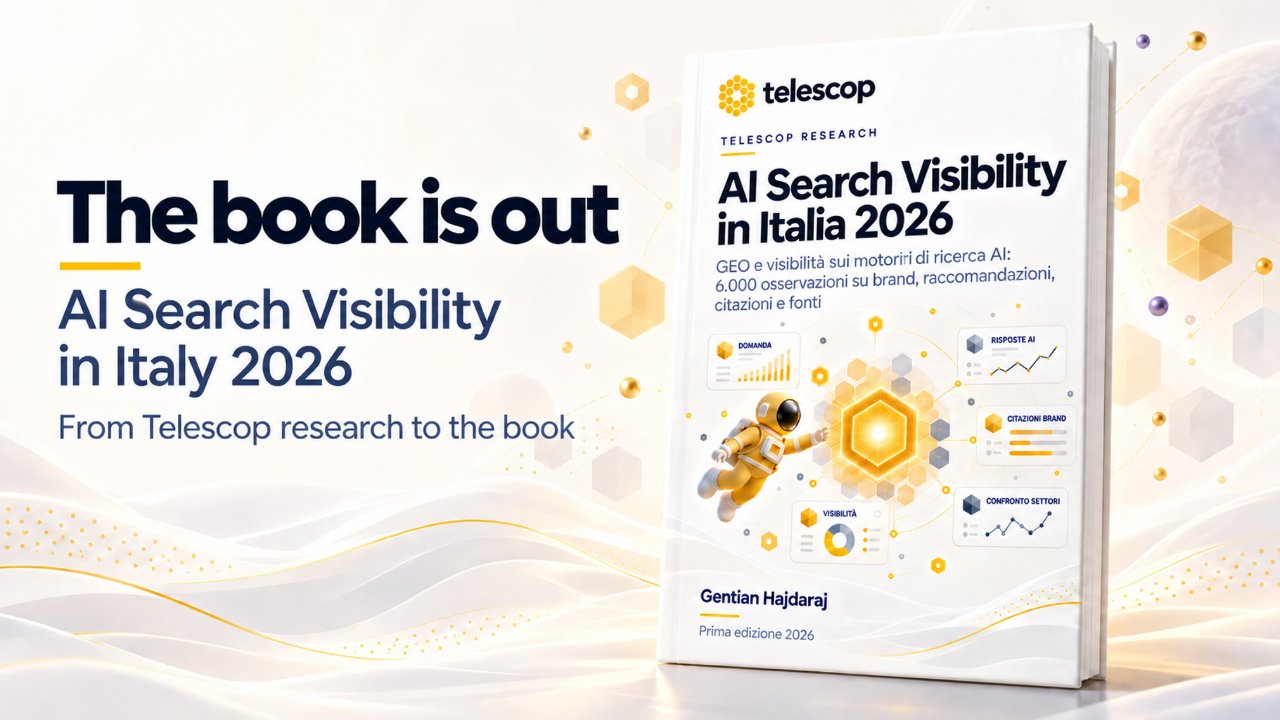
AI Search Visibility in Italy 2026 is now available: the book by Gentian Hajdaraj born from Telescop research on 6,000 observations across AI search surfaces.

Indice dei contenuti
Artificial intelligence is changing a fundamental part of digital marketing: the way people and companies discover, compare and choose brands, products, services and professionals.
For many years, a large part of online visibility could be summarized with a relatively simple question: “Where do we rank on Google?”
Today, that question is no longer enough.
Increasingly, search can begin directly as a conversation: which are the best companies for this service? Which solution should I choose? Which tools are best suited to my case? Which brands are considered trustworthy?
And the answer can be generated directly by ChatGPT, Gemini or Google’s new AI search experiences.
This shift led to the work we developed with Telescop and, later, to the book AI Search Visibility in Italia 2026.
The book is now available on Amazon:
AI Search Visibility in Italia 2026 on Amazon
The research behind the book
Before the book came the independent research published by Telescop:
AI Search Visibility in Italia 2026: the full Telescop research
The project started from a very concrete question:
When a user asks an AI system for information, comparisons or recommendations in a market, which brands are actually mentioned?
To investigate this, we built an observation system across different AI surfaces and collected about 6,000 observations, analyzing how brands appear in generated answers.
The goal was not to produce yet another study about AI adoption. We wanted to observe directly what AI systems actually answer.
The most important finding: there is no single AI visibility
One of the most interesting findings is also one of the easiest to underestimate:
there is no single “AI visibility”.
A brand may be highly visible on one platform and almost absent on another. It may emerge for some types of questions and disappear for others. It may have strong traditional organic visibility without being recommended by AI systems.
ChatGPT, Gemini and Google’s different AI experiences should therefore not be treated as a single search engine. They are different surfaces, with different behaviors.
From ranking to recommendation
Perhaps the most important change concerns the very idea of visibility.
Traditional SEO has accustomed us to a model such as:
keyword → results → ranking → click → website
With AI Search, the path can become:
question → interpretation → source selection → answer → recommendation
The difference is not only technical. It is strategic.
If a potential customer asks an AI system which companies are best for a given service, the AI can already narrow the market down to a small set of names. Appearing in that answer means entering the customer’s consideration set; being absent means potentially never being evaluated at all.
From keywords to prompts
In traditional search, we learned to study keywords. In the AI era, we also need to think about prompts and questions that represent real market intent.
It is no longer enough to ask “which keywords do I rank for?”. More useful questions include:
- Which problems is my brand associated with as a solution?
- When recommendations are requested, does my brand appear?
- In which categories?
- Alongside which competitors?
- How frequently?
- On which platforms?
- Which sources are used?
- What is being said about the brand?
This is a level of observation that goes beyond traditional rankings and connects directly with the evolution of SEO and digital marketing.
Why sources matter even more
Companies can control what they publish on their own websites. They cannot fully control what the rest of the web says about them.
This is where the relationship between SEO, digital PR, brand authority, reviews, citations and AI visibility becomes especially important.
AI systems may encounter a brand through many other signals: third-party articles, reviews, directories, comparisons, studies, datasets, citations, communities, specialist sources and documentation.
This means that AI visibility may increasingly become the result of a distributed ecosystem of evidence across the web, rather than simply an optimized page.
The research behind the book
Research:
AI Search Visibility in Italia 2026 – Telescop
Observations analyzed:
about 6,000
Research focus:
the presence and recommendation of brands in answers generated by AI Search systems.
Objective:
to understand how visibility changes when search no longer returns only a list of links, but directly generates an answer.
The research provides the observational and methodological layer. The book takes the next step: interpreting those findings and translating them into implications and recommendations for companies and professionals.
Why I decided to publish the book
While working on Telescop, I realized that simply presenting numbers would not be enough.
The interesting question is not only whether a brand appears in 10%, 20% or 50% of the answers we observe. We need to understand why.
Why is a competitor cited? Which signals appear to strengthen it? Which sources are used? For which questions does it emerge? Where does it disappear? And above all: what can a company actually do to improve its position?
The book was written to explore this second layer: not only measurement, but interpretation.
SEO and AI Search: continuity or revolution?
Probably both.
Assuming SEO will suddenly become irrelevant would be simplistic. Many fundamentals remain important: technically accessible websites, useful content, information architecture, understandable entities, authority, reputation, links, citations and reliable sources.
What changes is the context in which those signals are used.
A traditional search engine must decide which documents to show. A generative system may need to decide which information to use to build an answer and which entities to recommend.
Measure before optimizing
This is one of the principles that also led to the development of Telescop.
Before talking about “optimization for ChatGPT” or GEO, we need to answer some basic questions:
- Where are we visible today?
- Where are we absent?
- Which competitors appear instead of us?
- For which questions?
- On which platforms?
- Which sources appear to support those answers?
Only then does it make sense to decide what to improve. Otherwise, the risk is to build strategies around impressions or isolated manual tests.
From research to a continuous observatory
The book is a snapshot. Telescop has a different ambition: to turn that snapshot into a continuous observation system.
AI answers are not static. Models change. Sources change. Companies change. Available information changes. User questions change. Recommendations change.
For this reason, I see AI Search Visibility in Italia 2026 not as the end point of the research, but as an initial baseline: a useful snapshot against which future changes can be compared.
Where to find the book and the research
If you want to start from the data and methodology:
→ Read the AI Search Visibility in Italia 2026 research on Telescop
If you want to explore the phenomenon, its implications and recommendations in more depth:
→ Discover AI Search Visibility in Italia 2026 on Amazon
We are probably still at the beginning of this transformation. But one change is already becoming clear.
Digital visibility is no longer only about where your website appears.
It is increasingly about what AI systems know about us, how they interpret our brand and whether they decide to include it in the answers and recommendations they provide to users.
That is what we will continue to observe.
Condividi questa storia, scegli tu dove!




About the Author: Gentian Hajdaraj